
Dr. Federico Favi ist Postdoctoral Fellow an der Faculty of Classics der Universität Oxford sowie Junior Research Fellow am Oriel College.
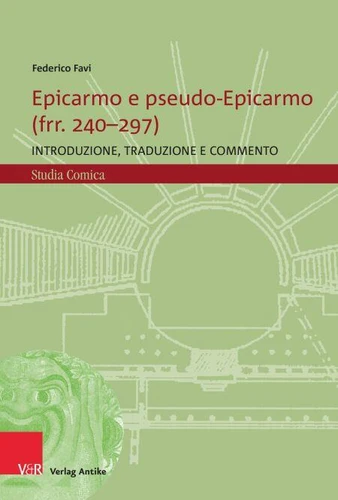
Epicarmo e pseudo-Epicarmo (frr. 240–297). Introduzione, traduzione e commento
Par :Formats :
Disponible dans votre compte client Decitre ou Furet du Nord dès validation de votre commande. Le format PDF est :
- Compatible avec une lecture sur My Vivlio (smartphone, tablette, ordinateur)
- Compatible avec une lecture sur liseuses Vivlio
- Pour les liseuses autres que Vivlio, vous devez utiliser le logiciel Adobe Digital Edition. Non compatible avec la lecture sur les liseuses Kindle, Remarkable et Sony
 , qui est-ce ?
Notre partenaire de plateforme de lecture numérique où vous retrouverez l'ensemble de vos ebooks gratuitement
Pour en savoir plus sur nos ebooks, consultez notre aide en ligne ici
C'est si simple ! Lisez votre ebook avec l'app Vivlio sur votre tablette, mobile ou ordinateur :

- Nombre de pages448
- FormatPDF
- ISBN978-3-946317-86-9
- EAN9783946317869
- Date de parution07/09/2020
- Protection num.pas de protection
- Taille6 Mo
- Infos supplémentairespdf
- ÉditeurVandenhoeck & Ruprecht
Résumé
Epicharmus (ca. 530-440 BCE) is the first known Greek comic poet, but his influence in antiquity was in no way limited to dramatic literature. As the result of the interest in moral, linguistic, and philosophical subjects displayed in Epicharmus' comedies, after his death Epicharmus was believed to have had a real competence in those fields, and a number of moral, philosophical, and scientific treatises in verse, known as the pseudo-Epicharmean writings, were thus composed so as to collect and circulate the doctrines which came to be identified as Epicharmus'.
Beside discussing the evidence for serious subjects in Epicharmus' comedies, this volume provides an analytic study of the fragments from the pseudo-Epicharmean writings and makes a case for considering the so-called fragments ex Alcimo as genuine examples of philosophical parody from Epicharmus' authentic comedies. All these materials are presented with a revised text and a word-by-word philological and exegetical commentary.
Beside discussing the evidence for serious subjects in Epicharmus' comedies, this volume provides an analytic study of the fragments from the pseudo-Epicharmean writings and makes a case for considering the so-called fragments ex Alcimo as genuine examples of philosophical parody from Epicharmus' authentic comedies. All these materials are presented with a revised text and a word-by-word philological and exegetical commentary.
A propos de Federico Favi
85,00 €