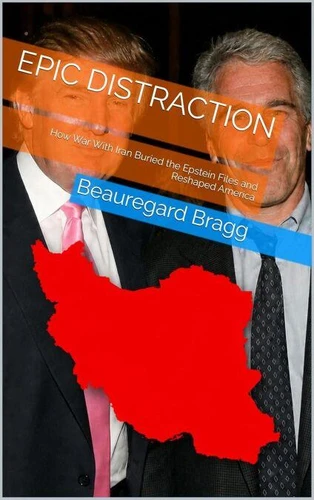
What happens when a democracy changes the subject at the exact moment accountability is closing in?Epic Distraction investigates the week America's attention pivoted from mounting pressure over the Epstein files to military escalation with Iran-and asks what that shift revealed about war, media, money, and power. Beauregard Calhoun Bragg examines Operation Epic Fury not as a simple conspiracy, but as a case study in how modern crises function: threat narratives narrow debate, cable news rewards spectacle, Congress funds consequences after the fact, and debt-financed war allows political leaders to act now while sending the bill into the future.
At the center of the book is a hard question: did war with Iran politically bury one of the most sensitive accountability fights in America, even if that was not its sole or proven purpose?Through constitutional analysis, war economics, media criticism, and human-centered storytelling, Epic Distraction follows the money and the incentives behind the crisis. It traces how early estimates of at least $29 billion in aircraft and operational costs were only the opening act of a much larger fiscal burden: missile replenishment, naval deployments, emergency appropriations, contractor profits, debt service, veterans' care, oil shocks, and invisible domestic tradeoffs.
The book argues that America's permanent emergency politics have created a modern military-industrial-media complex-one in which fear generates ratings, war generates contracts, borrowing hides the true cost, and democratic scrutiny is postponed until after the decisive choices have already been made. But this is not a book of easy slogans. Bragg carefully separates evidence from suspicion, effect from intent, and documented cost from political interpretation.
Iran is treated as a real strategic problem, not an invented enemy. The Epstein files are treated as an unresolved accountability crisis, not a prop. The question is not whether every event was secretly planned. The question is whether American institutions are now structured so that emergency reliably protects power from sustained public scrutiny. From Tehran to Houston, from cable studios to congressional hearing rooms, from military families to future taxpayers, Epic Distraction shows how war reaches far beyond the battlefield.
It reaches the gas pump, the grocery bill, the school repair that never happens, the clinic that cannot expand, the veteran waiting for care, and the citizen asked to trust classified claims while paying public costs. The book ends with a warning and a challenge: democracy cannot survive if every demand for accountability can be drowned out by the next crisis. If citizens are to reclaim control over war, budgets, and public attention, they must demand records, votes, audits, cost estimates, transparency, and the power to say no before yes becomes inevitable.
What happens when a democracy changes the subject at the exact moment accountability is closing in?Epic Distraction investigates the week America's attention pivoted from mounting pressure over the Epstein files to military escalation with Iran-and asks what that shift revealed about war, media, money, and power. Beauregard Calhoun Bragg examines Operation Epic Fury not as a simple conspiracy, but as a case study in how modern crises function: threat narratives narrow debate, cable news rewards spectacle, Congress funds consequences after the fact, and debt-financed war allows political leaders to act now while sending the bill into the future.
At the center of the book is a hard question: did war with Iran politically bury one of the most sensitive accountability fights in America, even if that was not its sole or proven purpose?Through constitutional analysis, war economics, media criticism, and human-centered storytelling, Epic Distraction follows the money and the incentives behind the crisis. It traces how early estimates of at least $29 billion in aircraft and operational costs were only the opening act of a much larger fiscal burden: missile replenishment, naval deployments, emergency appropriations, contractor profits, debt service, veterans' care, oil shocks, and invisible domestic tradeoffs.
The book argues that America's permanent emergency politics have created a modern military-industrial-media complex-one in which fear generates ratings, war generates contracts, borrowing hides the true cost, and democratic scrutiny is postponed until after the decisive choices have already been made. But this is not a book of easy slogans. Bragg carefully separates evidence from suspicion, effect from intent, and documented cost from political interpretation.
Iran is treated as a real strategic problem, not an invented enemy. The Epstein files are treated as an unresolved accountability crisis, not a prop. The question is not whether every event was secretly planned. The question is whether American institutions are now structured so that emergency reliably protects power from sustained public scrutiny. From Tehran to Houston, from cable studios to congressional hearing rooms, from military families to future taxpayers, Epic Distraction shows how war reaches far beyond the battlefield.
It reaches the gas pump, the grocery bill, the school repair that never happens, the clinic that cannot expand, the veteran waiting for care, and the citizen asked to trust classified claims while paying public costs. The book ends with a warning and a challenge: democracy cannot survive if every demand for accountability can be drowned out by the next crisis. If citizens are to reclaim control over war, budgets, and public attention, they must demand records, votes, audits, cost estimates, transparency, and the power to say no before yes becomes inevitable.

 , qui est-ce ?
