SOLDES
Jusqu'à -70% sur une sélection d'articles*

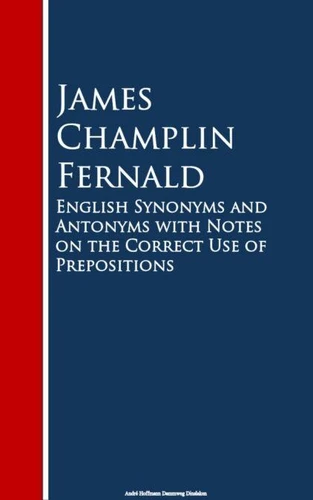
English Synonyms and Antonyms with Notes on the Crect Use of Prepositions
Par :Formats :
Disponible dans votre compte client Decitre ou Furet du Nord dès validation de votre commande. Le format ePub est :
- Compatible avec une lecture sur My Vivlio (smartphone, tablette, ordinateur)
- Compatible avec une lecture sur liseuses Vivlio
- Pour les liseuses autres que Vivlio, vous devez utiliser le logiciel Adobe Digital Edition. Non compatible avec la lecture sur les liseuses Kindle, Remarkable et Sony
 , qui est-ce ?
Notre partenaire de plateforme de lecture numérique où vous retrouverez l'ensemble de vos ebooks gratuitement
Pour en savoir plus sur nos ebooks, consultez notre aide en ligne ici
C'est si simple ! Lisez votre ebook avec l'app Vivlio sur votre tablette, mobile ou ordinateur :

- Nombre de pages500
- FormatePub
- ISBN978-3-7364-1151-7
- EAN9783736411517
- Date de parution01/09/2016
- Protection num.Digital Watermarking
- Taille693 Ko
- Infos supplémentairesepub
- ÉditeurAndhof
Résumé
A Practical and Invaluable Guide to Clear and
Precise Diction for Writers, Speakers, Students,
Business and Professional.
The English language is peculiarly rich in synonyms, as, with such a history, it could not fail to be. From the time of Julius Caesar, Britons, Romans, Northmen, Saxons, Danes, and Normans fighting, fortifying, and settling upon the HOI! of England, with Scotch and Irish contending 1 for mastery or existence across the mountain border and the Channel, and all fenced in together by the sea, could not but influence one another's speech.
English merchants, Bailors, soldiers, and travelers, trading, warring, and exploring in every clime, of necessity brought back new terms of sea and shore, of shop and camp and battle-Held. English scholars have studied Greek and Latin for a thousand years, and the languages of the Continent and of the Orient in more recent times, English churchmen have introduced worda from Hebrew, Greek, and Latin, through Bible and prayer-book, sermon and tract.
Prom all this it results that there is scarcely A language ever spoken among men that has not omo representative in English speech. The spirit of the Anglo-Saxon race, masterful in language as in war and commerce, han subjugated all these various elements to one idiom, making not a patchwork, but a composite language. An^lo-Saxon thrift, finding often several words that originally expressed the same, idea, has detailed them to different parts of the common territory or to different service, so that we have an almont unexampled variety of words, kindred in meaning but distinct in usage, for expressing almost every shade of human thought.
English merchants, Bailors, soldiers, and travelers, trading, warring, and exploring in every clime, of necessity brought back new terms of sea and shore, of shop and camp and battle-Held. English scholars have studied Greek and Latin for a thousand years, and the languages of the Continent and of the Orient in more recent times, English churchmen have introduced worda from Hebrew, Greek, and Latin, through Bible and prayer-book, sermon and tract.
Prom all this it results that there is scarcely A language ever spoken among men that has not omo representative in English speech. The spirit of the Anglo-Saxon race, masterful in language as in war and commerce, han subjugated all these various elements to one idiom, making not a patchwork, but a composite language. An^lo-Saxon thrift, finding often several words that originally expressed the same, idea, has detailed them to different parts of the common territory or to different service, so that we have an almont unexampled variety of words, kindred in meaning but distinct in usage, for expressing almost every shade of human thought.