
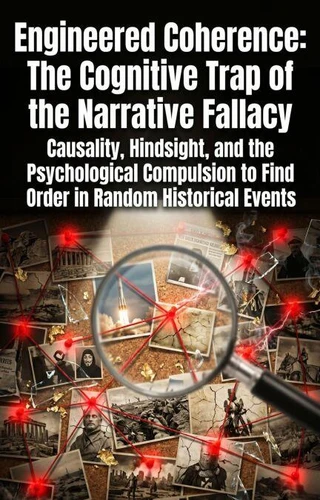
Engineered Coherence: The Cognitive Trap of the Narrative Fallacy. Causality, Hindsight, and the Psychological Compulsion to Find Order in Random Historical Events
Par :Formats :
Disponible dans votre compte client Decitre ou Furet du Nord dès validation de votre commande. Le format ePub est :
- Compatible avec une lecture sur My Vivlio (smartphone, tablette, ordinateur)
- Compatible avec une lecture sur liseuses Vivlio
- Pour les liseuses autres que Vivlio, vous devez utiliser le logiciel Adobe Digital Edition. Non compatible avec la lecture sur les liseuses Kindle, Remarkable et Sony
 , qui est-ce ?
Notre partenaire de plateforme de lecture numérique où vous retrouverez l'ensemble de vos ebooks gratuitement
Pour en savoir plus sur nos ebooks, consultez notre aide en ligne ici
C'est si simple ! Lisez votre ebook avec l'app Vivlio sur votre tablette, mobile ou ordinateur :

- Nombre de pages188
- FormatePub
- ISBN978-3-565-42289-0
- EAN9783565422890
- Date de parution21/04/2026
- Protection num.pas de protection
- Taille772 Ko
- Infos supplémentairesepub
- ÉditeurEmphaloz Publishing House
Résumé
Why are humans so obsessed with writing neat, logical stories about how the past inevitably led to the present, when in reality, the timeline was driven almost entirely by chaotic, unpredictable randomness? This desperate psychological need for order is known in behavioral economics as the Narrative Fallacy.
Popularized by Nassim Nicholas Taleb, the narrative fallacy describes our brain's biological inability to process raw, disconnected facts without weaving them into a cohesive story.
We look back at a successful startup, a stock market crash, or a historical war, and we artificially stitch together a few prominent details to create a clear "cause-and-effect" explanation. This retrospective illusion gives us a false sense of control over the world, but it becomes incredibly dangerous when we use these fabricated, oversimplified historical stories to confidently predict the highly complex, chaotic future. This rigorous psychological analysis deconstructs the illusion of predictability.
It explores the flaws in modern historical journalism, the danger of CEO biographies, and the cognitive relief of admitting that sometimes, things just happen for absolutely no reason at all. Stop rewriting the past. Understanding the narrative fallacy is the ultimate cognitive defense against the comforting, dangerous lies we tell ourselves to avoid the terrifying reality of randomness.
We look back at a successful startup, a stock market crash, or a historical war, and we artificially stitch together a few prominent details to create a clear "cause-and-effect" explanation. This retrospective illusion gives us a false sense of control over the world, but it becomes incredibly dangerous when we use these fabricated, oversimplified historical stories to confidently predict the highly complex, chaotic future. This rigorous psychological analysis deconstructs the illusion of predictability.
It explores the flaws in modern historical journalism, the danger of CEO biographies, and the cognitive relief of admitting that sometimes, things just happen for absolutely no reason at all. Stop rewriting the past. Understanding the narrative fallacy is the ultimate cognitive defense against the comforting, dangerous lies we tell ourselves to avoid the terrifying reality of randomness.