
Nouveauté
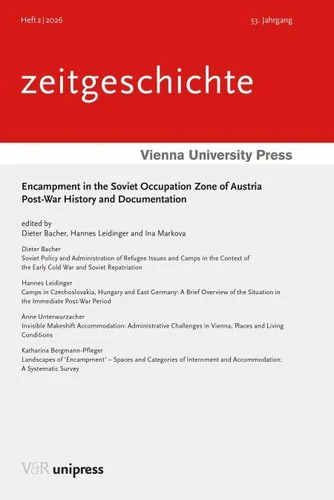
Encampment in the Soviet Occupation Zone of Austria. Post-War History and Documentation
Par : , ,Formats :
Disponible dans votre compte client Decitre ou Furet du Nord dès validation de votre commande. Le format PDF est :
- Compatible avec une lecture sur My Vivlio (smartphone, tablette, ordinateur)
- Compatible avec une lecture sur liseuses Vivlio
- Pour les liseuses autres que Vivlio, vous devez utiliser le logiciel Adobe Digital Edition. Non compatible avec la lecture sur les liseuses Kindle, Remarkable et Sony
 , qui est-ce ?
Notre partenaire de plateforme de lecture numérique où vous retrouverez l'ensemble de vos ebooks gratuitement
Pour en savoir plus sur nos ebooks, consultez notre aide en ligne ici
C'est si simple ! Lisez votre ebook avec l'app Vivlio sur votre tablette, mobile ou ordinateur :

- Nombre de pages137
- FormatPDF
- ISBN978-3-8470-1996-1
- EAN9783847019961
- Date de parution13/07/2026
- Protection num.pas de protection
- Taille10 Mo
- Infos supplémentairespdf
- ÉditeurV&R Unipress
Résumé
Between 1945 and 1955, hundreds of camps existed in the Soviet occupation zone of Austria. They served the internment and accommodation of displaced persons, repatriates, former prisoners of war, expellees, former National Socialists, and segments of the Austrian civilian population. Yet these camps have long remained marginal in scholarship and only weakly anchored in collective memory. This volume presents the results of the FWF project "Encampment" and offers the first systematic reconstruction of the camp landscape in the Soviet zone in post-war Austria.
Drawing on extensive archival research, local investigations, and in-depth analysis on several examples of camp infrastructure, it examines structures, actors, functions, and continuities. Particular attention is paid to factors like trajectories into and out of the camps or questions of agency. Additionally, a digital map including details on the 247 identified sites is available.
Drawing on extensive archival research, local investigations, and in-depth analysis on several examples of camp infrastructure, it examines structures, actors, functions, and continuities. Particular attention is paid to factors like trajectories into and out of the camps or questions of agency. Additionally, a digital map including details on the 247 identified sites is available.