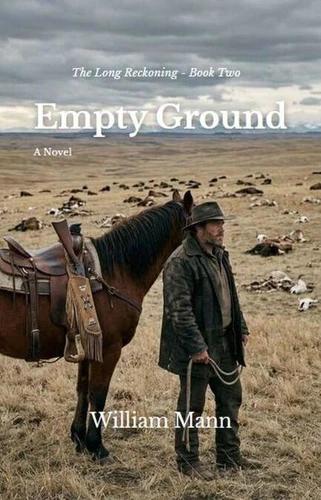
In 1849, a seventeen-year-old Irish immigrant named Declan Shea stands at the Powder River and watches sixty million buffalo come over a rise. By 1883, he rides the same country and cannot find eleven. Between those two moments lies a life. Declan learns his trade on the northern plains-the Sharps rifle, the skinning knife, the arithmetic of a hide taken clean. He takes a Cheyenne name he did not choose: Heávohe.
He works beside a ruined man named Bill until the day Bill stops working. He crosses paths with a Crow woman named Ashkáale in a willow draw and keeps crossing paths with her for twenty-five years without ever finding the four words that might have mattered. Told in the spare, unsparing prose of American literary realism, Empty Ground is the story of a man who understood exactly what he was doing on a continent that had decided to let him do it-and of the people who watched it happen from the ground they were losing.
For readers of Paulette Jiles, James Welch, Guy Vanderhaeghe, and Kent Haruf.
In 1849, a seventeen-year-old Irish immigrant named Declan Shea stands at the Powder River and watches sixty million buffalo come over a rise. By 1883, he rides the same country and cannot find eleven. Between those two moments lies a life. Declan learns his trade on the northern plains-the Sharps rifle, the skinning knife, the arithmetic of a hide taken clean. He takes a Cheyenne name he did not choose: Heávohe.
He works beside a ruined man named Bill until the day Bill stops working. He crosses paths with a Crow woman named Ashkáale in a willow draw and keeps crossing paths with her for twenty-five years without ever finding the four words that might have mattered. Told in the spare, unsparing prose of American literary realism, Empty Ground is the story of a man who understood exactly what he was doing on a continent that had decided to let him do it-and of the people who watched it happen from the ground they were losing.
For readers of Paulette Jiles, James Welch, Guy Vanderhaeghe, and Kent Haruf.