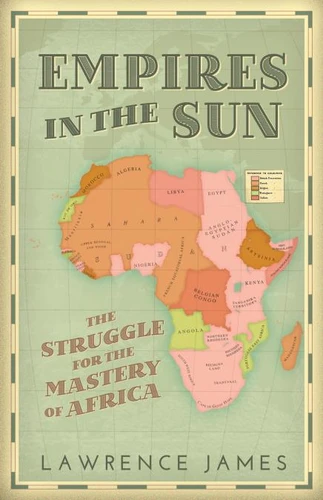
Empires in the Sun. The Struggle for the Mastery of Africa
Par :Formats :
Disponible dans votre compte client Decitre ou Furet du Nord dès validation de votre commande. Le format ePub protégé est :
- Compatible avec une lecture sur My Vivlio (smartphone, tablette, ordinateur)
- Compatible avec une lecture sur liseuses Vivlio
- Pour les liseuses autres que Vivlio, vous devez utiliser le logiciel Adobe Digital Edition. Non compatible avec la lecture sur les liseuses Kindle, Remarkable et Sony
- Non compatible avec un achat hors France métropolitaine
 , qui est-ce ?
Notre partenaire de plateforme de lecture numérique où vous retrouverez l'ensemble de vos ebooks gratuitement
Pour en savoir plus sur nos ebooks, consultez notre aide en ligne ici
C'est si simple ! Lisez votre ebook avec l'app Vivlio sur votre tablette, mobile ou ordinateur :

- Nombre de pages416
- FormatePub
- ISBN978-0-297-87029-6
- EAN9780297870296
- Date de parution02/11/2016
- Protection num.Adobe DRM
- Infos supplémentairesepub
- ÉditeurWeidenfeld & Nicolson
Résumé
In this compelling history of the men and ideas that radically changed the course of world history, Lawrence James investigates and analyses how, within a hundred years, Europeans persuaded and coerced Africa into becoming a subordinate part of the modern world. His narrative is laced with the experiences of participants and onlookers and introduces the men and women who, for better or worse, stamped their wills on Africa.
The continent was a magnet for the high-minded, the philanthropic, the unscrupulous and the insane. Visionary pro-consuls rubbed shoulders with missionaries, explorers, soldiers, adventurers, engineers, big-game hunters, entrepreneurs and physicians. Between 1830 and 1945, Britain, France, Belgium, Germany, Portugal, Italy and the United States exported their languages, laws, culture, religions, scientific and technical knowledge and economic systems to Africa.
The colonial powers imposed administrations designed to bring stability and peace to a continent that seemed to lack both. The justification for occupation was emancipation from slavery - and the common assumption that late nineteenth-century Europe was the summit of civilisation. By 1945 a transformed continent was preparing to take charge of its own affairs, a process of decolonisation that took a mere twenty or so years.
Yet there remained areas where European influence was limited (Liberia, Abyssinia). Through inertia and a desire for a quiet time, Africa's new masters left much undisturbed, and so this magnificent history also pauses to ask: what did not happen and why?
The continent was a magnet for the high-minded, the philanthropic, the unscrupulous and the insane. Visionary pro-consuls rubbed shoulders with missionaries, explorers, soldiers, adventurers, engineers, big-game hunters, entrepreneurs and physicians. Between 1830 and 1945, Britain, France, Belgium, Germany, Portugal, Italy and the United States exported their languages, laws, culture, religions, scientific and technical knowledge and economic systems to Africa.
The colonial powers imposed administrations designed to bring stability and peace to a continent that seemed to lack both. The justification for occupation was emancipation from slavery - and the common assumption that late nineteenth-century Europe was the summit of civilisation. By 1945 a transformed continent was preparing to take charge of its own affairs, a process of decolonisation that took a mere twenty or so years.
Yet there remained areas where European influence was limited (Liberia, Abyssinia). Through inertia and a desire for a quiet time, Africa's new masters left much undisturbed, and so this magnificent history also pauses to ask: what did not happen and why?
A propos de Lawrence James
3,99 €
3,99 €
3,99 €