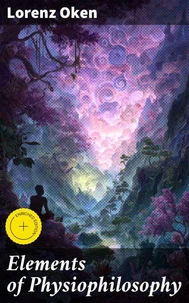
Elements of Physiophilosophy
Par : ,Formats :
Disponible dans votre compte client Decitre ou Furet du Nord dès validation de votre commande. Le format ePub est :
- Compatible avec une lecture sur My Vivlio (smartphone, tablette, ordinateur)
- Compatible avec une lecture sur liseuses Vivlio
- Pour les liseuses autres que Vivlio, vous devez utiliser le logiciel Adobe Digital Edition. Non compatible avec la lecture sur les liseuses Kindle, Remarkable et Sony
 , qui est-ce ?
Notre partenaire de plateforme de lecture numérique où vous retrouverez l'ensemble de vos ebooks gratuitement
Pour en savoir plus sur nos ebooks, consultez notre aide en ligne ici
C'est si simple ! Lisez votre ebook avec l'app Vivlio sur votre tablette, mobile ou ordinateur :

- Nombre de pages563
- FormatePub
- ISBN859-65--4703513-8
- EAN8596547035138
- Date de parution03/06/2022
- Protection num.Digital Watermarking
- Taille892 Ko
- Infos supplémentairesepub
- ÉditeurDIGICAT
Résumé
In "Elements of Physiophilosophy, " Lorenz Oken presents a pioneering exploration of the relationship between biology and philosophical inquiry. Oken's literary style combines lyrical prose with rigorous scientific argumentation, reflecting the intellectual currents of early 19th-century Europe, when thinkers sought to reconcile the emerging natural sciences with philosophical traditions. His work intricately weaves concepts from morphology, embryology, and systematics, positioning biology as a key to unlocking the mysteries of existence and connecting the microcosm of individual organisms to the macrocosm of life itself.
Oken, a German naturalist, philosopher, and one of the foremost figures in the field of Naturphilosophie, drew upon the works of Kant, Goethe, and Schelling, situating his own ideas within a broader philosophical discourse. His background in both medicine and natural history influenced his vision of a unified science, wherein philosophical thought and empirical observation coexist harmoniously. "Elements of Physiophilosophy" serves as a culmination of his life's work, challenging the boundaries of both science and philosophy.
For scholars, students, and enthusiasts of both philosophy and science, Oken's "Elements of Physiophilosophy" is an essential read. Its ability to provoke thought and inspire a holistic understanding of life makes this book a cornerstone for those seeking to comprehend the intricate connections between biology, philosophy, and the natural world.
Oken, a German naturalist, philosopher, and one of the foremost figures in the field of Naturphilosophie, drew upon the works of Kant, Goethe, and Schelling, situating his own ideas within a broader philosophical discourse. His background in both medicine and natural history influenced his vision of a unified science, wherein philosophical thought and empirical observation coexist harmoniously. "Elements of Physiophilosophy" serves as a culmination of his life's work, challenging the boundaries of both science and philosophy.
For scholars, students, and enthusiasts of both philosophy and science, Oken's "Elements of Physiophilosophy" is an essential read. Its ability to provoke thought and inspire a holistic understanding of life makes this book a cornerstone for those seeking to comprehend the intricate connections between biology, philosophy, and the natural world.