For decades, our schools have measured intelligence in only one way - through words and numbers. But what about the child who thinks in music? The student who solves problems through movement? The learner who sees the world in pictures, patterns, and possibility?In Eight Minds, Infinite Genius, educator and public health specialist Dr. Zerai Hagos makes the case that our education system isn't failing students - it's failing to see them.
Drawing on Howard Gardner's groundbreaking theory of Multiple Intelligences and decades of neuroscience on how the brain actually learns, this book dismantles the "factory model" of education and offers something far more powerful in its place: a classroom built for every kind of mind. Through real stories from schools around the world, practical strategies teachers can use tomorrow, and a clear-eyed look at what happens when brilliance goes unrecognized, Dr.
Hagos shows that every child - the linguistic thinker and the kinesthetic one, the introvert and the natural-born leader - carries a genius worth cultivating. Part manifesto, part classroom toolkit, Eight Minds, Infinite Genius is a call to educators, parents, and policymakers alike: stop asking children to fit the system, and start building a system that fits the child.
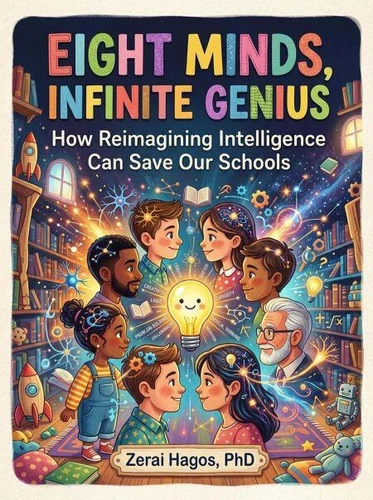
For decades, our schools have measured intelligence in only one way - through words and numbers. But what about the child who thinks in music? The student who solves problems through movement? The learner who sees the world in pictures, patterns, and possibility?In Eight Minds, Infinite Genius, educator and public health specialist Dr. Zerai Hagos makes the case that our education system isn't failing students - it's failing to see them.
Drawing on Howard Gardner's groundbreaking theory of Multiple Intelligences and decades of neuroscience on how the brain actually learns, this book dismantles the "factory model" of education and offers something far more powerful in its place: a classroom built for every kind of mind. Through real stories from schools around the world, practical strategies teachers can use tomorrow, and a clear-eyed look at what happens when brilliance goes unrecognized, Dr.
Hagos shows that every child - the linguistic thinker and the kinesthetic one, the introvert and the natural-born leader - carries a genius worth cultivating. Part manifesto, part classroom toolkit, Eight Minds, Infinite Genius is a call to educators, parents, and policymakers alike: stop asking children to fit the system, and start building a system that fits the child.


 , qui est-ce ?