
Nouveauté
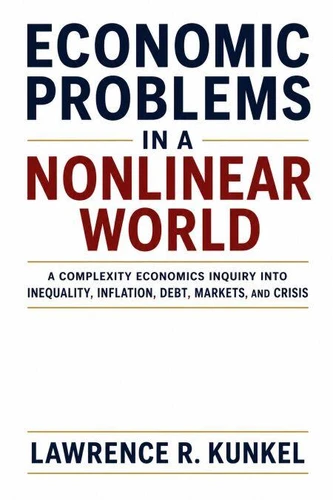
Economic Problems in a Nonlinear World
Par : ,Formats :
Disponible dans votre compte client Decitre ou Furet du Nord dès validation de votre commande. Le format ePub est :
- Compatible avec une lecture sur My Vivlio (smartphone, tablette, ordinateur)
- Compatible avec une lecture sur liseuses Vivlio
- Pour les liseuses autres que Vivlio, vous devez utiliser le logiciel Adobe Digital Edition. Non compatible avec la lecture sur les liseuses Kindle, Remarkable et Sony
 , qui est-ce ?
Notre partenaire de plateforme de lecture numérique où vous retrouverez l'ensemble de vos ebooks gratuitement
Pour en savoir plus sur nos ebooks, consultez notre aide en ligne ici
C'est si simple ! Lisez votre ebook avec l'app Vivlio sur votre tablette, mobile ou ordinateur :

- FormatePub
- ISBN8995385783
- EAN9798995385783
- Date de parution08/07/2026
- Protection num.pas de protection
- Infos supplémentairesepub
- ÉditeurLawrence R. Kunkel
Résumé
Economic Problems in a Nonlinear World offers a powerful new way to understand the crises of modern capitalism. Drawing on complexity economics, nonlinear dynamics, network theory, and moral political economy, Lawrence R. Kunkel argues that the most urgent economic problems of our time cannot be understood through the old language of equilibrium, efficiency, and isolated market transactions. Inequality, inflation, debt, market concentration, financial instability, labor disruption, ecological stress, and democratic fragility are not separate problems.
They are interconnected outcomes of an adaptive economic system in which feedback loops, thresholds, expectations, institutional trust, and power relations continually reshape one another. Modern economies do not move smoothly toward balance. They can settle into good or bad attractors. They can generate prosperity or stagnation, resilience or fragility, legitimacy or collapse. Small shocks can cascade through financial networks.
Gradual pressures can produce sudden systemic change. Individual choices by firms, households, investors, workers, and governments can create large-scale patterns that no one intended, including bubbles, bank runs, inflation expectations, labor shortages, supply-chain bottlenecks, inequality, and political distrust. This book challenges the assumption that markets are self-correcting mechanisms detached from moral and institutional life.
Economic systems are not merely price systems. They are moral-complex adaptive systems in which material outcomes, social trust, institutional legitimacy, ecological limits, and democratic stability are deeply entangled. At once analytical and urgent, Economic Problems in a Nonlinear World invites readers to rethink economic governance for an age of instability. It argues that policy must move beyond narrow technical adjustment and toward structural redesign capable of building fairer, more resilient, and more humane economies.
For readers interested in inequality, inflation, debt, markets, crisis, democratic stability, and the future of capitalism, this book offers a compelling framework for understanding why economic life has become so unstable and what kind of institutional imagination is required to repair it.
They are interconnected outcomes of an adaptive economic system in which feedback loops, thresholds, expectations, institutional trust, and power relations continually reshape one another. Modern economies do not move smoothly toward balance. They can settle into good or bad attractors. They can generate prosperity or stagnation, resilience or fragility, legitimacy or collapse. Small shocks can cascade through financial networks.
Gradual pressures can produce sudden systemic change. Individual choices by firms, households, investors, workers, and governments can create large-scale patterns that no one intended, including bubbles, bank runs, inflation expectations, labor shortages, supply-chain bottlenecks, inequality, and political distrust. This book challenges the assumption that markets are self-correcting mechanisms detached from moral and institutional life.
Economic systems are not merely price systems. They are moral-complex adaptive systems in which material outcomes, social trust, institutional legitimacy, ecological limits, and democratic stability are deeply entangled. At once analytical and urgent, Economic Problems in a Nonlinear World invites readers to rethink economic governance for an age of instability. It argues that policy must move beyond narrow technical adjustment and toward structural redesign capable of building fairer, more resilient, and more humane economies.
For readers interested in inequality, inflation, debt, markets, crisis, democratic stability, and the future of capitalism, this book offers a compelling framework for understanding why economic life has become so unstable and what kind of institutional imagination is required to repair it.