
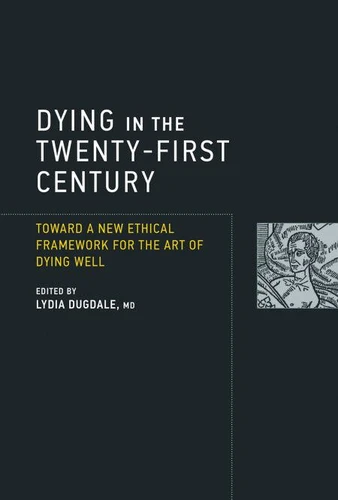
Dying in the Twenty-First Century. Toward a New Ethical Framework for the Art of Dying Well
Par :Formats :
Disponible dans votre compte client Decitre ou Furet du Nord dès validation de votre commande. Le format ePub protégé est :
- Compatible avec une lecture sur My Vivlio (smartphone, tablette, ordinateur)
- Compatible avec une lecture sur liseuses Vivlio
- Pour les liseuses autres que Vivlio, vous devez utiliser le logiciel Adobe Digital Edition. Non compatible avec la lecture sur les liseuses Kindle, Remarkable et Sony
- Non compatible avec un achat hors France métropolitaine
 , qui est-ce ?
Notre partenaire de plateforme de lecture numérique où vous retrouverez l'ensemble de vos ebooks gratuitement
Pour en savoir plus sur nos ebooks, consultez notre aide en ligne ici
C'est si simple ! Lisez votre ebook avec l'app Vivlio sur votre tablette, mobile ou ordinateur :

- Nombre de pages224
- FormatePub
- ISBN978-0-262-32858-6
- EAN9780262328586
- Date de parution29/05/2015
- Protection num.Adobe DRM
- Taille349 Ko
- Infos supplémentairesepub
- ÉditeurThe MIT Press
Résumé
Physicians, philosophers, and theologians consider how to address death and dying for a diverse population in a secularized century. Most of us are generally ill-equipped for dying. Today, we neither see death nor prepare for it. But this has not always been the case. In the early fifteenth century, the Roman Catholic Church published the Ars moriendi texts, which established prayers and practices for an art of dying.
In the twenty-first century, physicians rely on procedures and protocols for the efficient management of hospitalized patients. How can we recapture an art of dying that can facilitate our dying well? In this book, physicians, philosophers, and theologians attempt to articulate a bioethical framework for dying well in a secularized, diverse society. Contributors discuss such topics as the acceptance of human finitude; the role of hospice and palliative medicine; spiritual preparation for death; and the relationship between community, and individual autonomy.
They also consider special cases, including children, elderly patients with dementia, and death in the early years of the AIDS epidemic, when doctors could do little more than accompany their patients in humble solidarity. These chapters make the case for a robust bioethics-one that could foster both the contemplation of finitude and the cultivation of community that would be necessary for a contemporary art of dying well.
ContributorsJeffrey P. Bishop, Lisa Sowle Cahill, Daniel Callahan, Farr A. Curlin, Lydia S. Dugdale, Michelle Harrington, John Lantos, Stephen R. Latham, M. Therese Lysaught, Autumn Alcott Ridenour, Peter A. Selwyn, Daniel Sulmasy
In the twenty-first century, physicians rely on procedures and protocols for the efficient management of hospitalized patients. How can we recapture an art of dying that can facilitate our dying well? In this book, physicians, philosophers, and theologians attempt to articulate a bioethical framework for dying well in a secularized, diverse society. Contributors discuss such topics as the acceptance of human finitude; the role of hospice and palliative medicine; spiritual preparation for death; and the relationship between community, and individual autonomy.
They also consider special cases, including children, elderly patients with dementia, and death in the early years of the AIDS epidemic, when doctors could do little more than accompany their patients in humble solidarity. These chapters make the case for a robust bioethics-one that could foster both the contemplation of finitude and the cultivation of community that would be necessary for a contemporary art of dying well.
ContributorsJeffrey P. Bishop, Lisa Sowle Cahill, Daniel Callahan, Farr A. Curlin, Lydia S. Dugdale, Michelle Harrington, John Lantos, Stephen R. Latham, M. Therese Lysaught, Autumn Alcott Ridenour, Peter A. Selwyn, Daniel Sulmasy