SOLDES
Jusqu'à -70% sur une sélection d'articles*

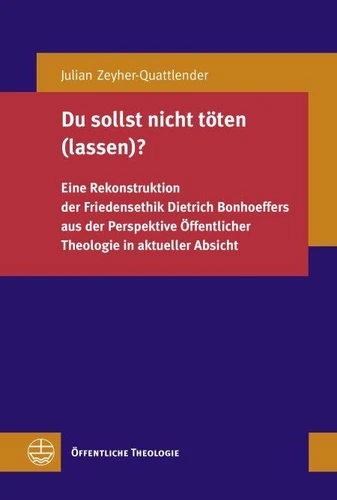
Du sollst nicht töten (lassen)?. Eine Rekonstruktion der Friedensethik Dietrich Bonhoeffers aus der Perspektive Öffentlicher Theologie in aktueller Absicht
Par :Formats :
Disponible dans votre compte client Decitre ou Furet du Nord dès validation de votre commande. Le format PDF est :
- Compatible avec une lecture sur My Vivlio (smartphone, tablette, ordinateur)
- Compatible avec une lecture sur liseuses Vivlio
- Pour les liseuses autres que Vivlio, vous devez utiliser le logiciel Adobe Digital Edition. Non compatible avec la lecture sur les liseuses Kindle, Remarkable et Sony
 , qui est-ce ?
Notre partenaire de plateforme de lecture numérique où vous retrouverez l'ensemble de vos ebooks gratuitement
Pour en savoir plus sur nos ebooks, consultez notre aide en ligne ici
C'est si simple ! Lisez votre ebook avec l'app Vivlio sur votre tablette, mobile ou ordinateur :

- Nombre de pages400
- FormatPDF
- ISBN978-3-374-06885-2
- EAN9783374068852
- Date de parution01/09/2021
- Protection num.Digital Watermarking
- Taille5 Mo
- Infos supplémentairespdf
- ÉditeurEvangelische Verlagsanstalt
Résumé
Du sollst nicht töten! Du sollst aber auch deinen Nächsten lieben wie dich selbst! Was also sollen Christenmenschen tun, wenn andere Menschen zum Ziel tödlicher Gewalt werden? Wie kann hier christliche Verantwortung für den Frieden angemessen wahrgenommen werden? Und sollte eine solche christliche Friedensethik auch in gesellschaftlichen Debatten, etwa um strukturelle Gewalt oder die Gewaltförmigkeit der Lebensweise des globalen Nordens ethische Orientierung bieten? Das Dilemma der Gewaltanwendung führt so auch hinein in die gegenwärtige Debatte um die Berechtigung einer Öffentlichen Theologie.
Die Studie beantwortet diese Fragen im Rückgriff auf die protestantische Tradition: In fundamentalethischer Absicht legt sie dabei im Zugriff auf Martin Luthers "Zwei-Reiche-Lehre" eine protestantische Aneignung Öffentlicher Theologie in Deutschland vor und in materialethischer Absicht erschließt sie Impulse der Friedensethik Dietrich Bonhoeffers für das 21.
Jahrhundert. [Thou Shalt Not Kill ? Reconstructing Dietrich Bonhoeffer's Ethics of Peace for Contemporary Discourse. A Contribution of Public Theology] Thou shalt not kill! But thou shalt also love thy neighbour as thyself! So what should Christians do when other people are targeted by lethal violence? How can Christian responsibility for peace be properly exercised here? And should such a Christian peace ethic also offer ethical orientation in public social debates, for example, about structural violence or the violence of the cultural way of life in the global North? The dilemma of peace ethics also leads into the current debate about the legitimacy of a public theology.
The study answers these questions with recourse to the Protestant tradition: From a fundamental ethical perspective it presents a Protestant appropriation of public theology in Germany by reconstructing Martin Luther's "Two-Kingdoms-Doctrine", and from a material ethical perspective it updates impulses from Dietrich Bonhoeffer's peace ethics for the 21st century.
Jahrhundert. [Thou Shalt Not Kill ? Reconstructing Dietrich Bonhoeffer's Ethics of Peace for Contemporary Discourse. A Contribution of Public Theology] Thou shalt not kill! But thou shalt also love thy neighbour as thyself! So what should Christians do when other people are targeted by lethal violence? How can Christian responsibility for peace be properly exercised here? And should such a Christian peace ethic also offer ethical orientation in public social debates, for example, about structural violence or the violence of the cultural way of life in the global North? The dilemma of peace ethics also leads into the current debate about the legitimacy of a public theology.
The study answers these questions with recourse to the Protestant tradition: From a fundamental ethical perspective it presents a Protestant appropriation of public theology in Germany by reconstructing Martin Luther's "Two-Kingdoms-Doctrine", and from a material ethical perspective it updates impulses from Dietrich Bonhoeffer's peace ethics for the 21st century.