
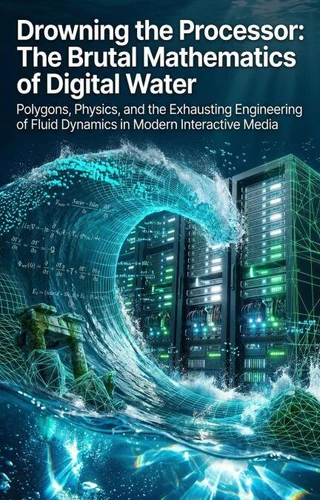
Drowning the Processor: The Brutal Mathematics of Digital Water. Polygons, Physics, and the Exhausting Engineering of Fluid Dynamics in Modern Interactive Media
Par :Formats :
Disponible dans votre compte client Decitre ou Furet du Nord dès validation de votre commande. Le format ePub est :
- Compatible avec une lecture sur My Vivlio (smartphone, tablette, ordinateur)
- Compatible avec une lecture sur liseuses Vivlio
- Pour les liseuses autres que Vivlio, vous devez utiliser le logiciel Adobe Digital Edition. Non compatible avec la lecture sur les liseuses Kindle, Remarkable et Sony
 , qui est-ce ?
Notre partenaire de plateforme de lecture numérique où vous retrouverez l'ensemble de vos ebooks gratuitement
Pour en savoir plus sur nos ebooks, consultez notre aide en ligne ici
C'est si simple ! Lisez votre ebook avec l'app Vivlio sur votre tablette, mobile ou ordinateur :

- Nombre de pages192
- FormatePub
- ISBN978-3-565-33897-9
- EAN9783565338979
- Date de parution19/03/2026
- Protection num.pas de protection
- Taille980 Ko
- Infos supplémentairesepub
- ÉditeurEmphaloz Publishing House
Résumé
In the history of video game development, nothing strikes fear into the heart of a programmer quite like a water level. Rendering a static, solid world is relatively easy. Rendering millions of colliding, refracting, and physics-driven liquid particles in real-time is a computational nightmare.
For decades, developers have fought a brutal war against the limits of hardware to simulate fluid dynamics.
Every crashing wave, buoyant barrel, and underwater light distortion requires massive compromises and brilliant mathematical shortcuts to prevent the game engine from grinding to an absolute halt. This analysis dissects the evolution of digital water. It explores the fake scrolling textures of the 16-bit era, the revolutionary physics hacks of early 3D engines, and the modern implementation of the Navier-Stokes equations that allow oceans to dynamically react to a player's movement. Whether you are an aspiring developer or a passionate player, this book pulls back the curtain on gaming's most notoriously difficult element.
Uncover the invisible algorithmic duct tape that holds your favorite aquatic environments together, and understand the sheer genius required to make code flow like a river.
Every crashing wave, buoyant barrel, and underwater light distortion requires massive compromises and brilliant mathematical shortcuts to prevent the game engine from grinding to an absolute halt. This analysis dissects the evolution of digital water. It explores the fake scrolling textures of the 16-bit era, the revolutionary physics hacks of early 3D engines, and the modern implementation of the Navier-Stokes equations that allow oceans to dynamically react to a player's movement. Whether you are an aspiring developer or a passionate player, this book pulls back the curtain on gaming's most notoriously difficult element.
Uncover the invisible algorithmic duct tape that holds your favorite aquatic environments together, and understand the sheer genius required to make code flow like a river.