
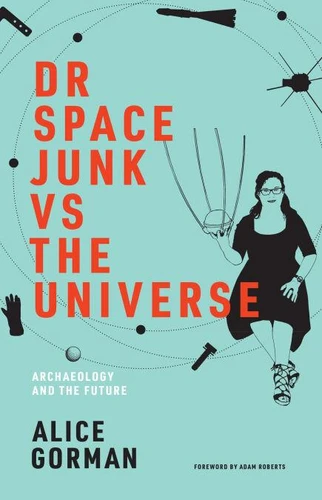
Dr Space Junk vs The Universe. Archaeology and the Future
Par : ,Formats :
Disponible dans votre compte client Decitre ou Furet du Nord dès validation de votre commande. Le format ePub protégé est :
- Compatible avec une lecture sur My Vivlio (smartphone, tablette, ordinateur)
- Compatible avec une lecture sur liseuses Vivlio
- Pour les liseuses autres que Vivlio, vous devez utiliser le logiciel Adobe Digital Edition. Non compatible avec la lecture sur les liseuses Kindle, Remarkable et Sony
- Non compatible avec un achat hors France métropolitaine
 , qui est-ce ?
Notre partenaire de plateforme de lecture numérique où vous retrouverez l'ensemble de vos ebooks gratuitement
Pour en savoir plus sur nos ebooks, consultez notre aide en ligne ici
C'est si simple ! Lisez votre ebook avec l'app Vivlio sur votre tablette, mobile ou ordinateur :

- Nombre de pages304
- FormatePub
- ISBN978-0-262-35713-5
- EAN9780262357135
- Date de parution22/10/2019
- Protection num.Adobe DRM
- Taille416 Ko
- Infos supplémentairesepub
- ÉditeurThe MIT Press
Résumé
Join a pioneering space archaeologist on a journey through the solar system and beyond as you explore artifacts left behind in space and on Earth-from moon dust to Elon Musk's red sports car. Alice Gorman is a space archaeologist: she examines the artifacts of human encounters with space. These objects, left behind on Earth and in space, can be massive (dead satellites in eternal orbit) or tiny (discarded zip ties around a defunct space antenna).
They can be bold (an American flag on the moon) or hopeful (messages from Earth sent into deep space). They raise interesting questions: Why did Elon Musk feel compelled to send a red Tesla into space? What accounts for the multiple rocket-themed playgrounds constructed after the Russians launched Sputnik? Gorman-affectionately known as "Dr Space Junk"-takes readers on a journey through the solar system and beyond, deploying space artifacts, historical explorations, and even the occasional cocktail recipe in search of the ways that we make space meaningful.
Engaging and erudite, Gorman recounts her background as a (nonspace) archaeologist and how she became interested in space artifacts. She shows us her own piece of space junk: a fragment of the fuel tank insulation from Skylab, the NASA spacecraft that crash-landed in Western Australia in 1979. She explains that the conventional view of the space race as "the triumph of the white, male American astronaut" seems inadequate; what really interests her, she says, is how everyday people engage with space.
To an archaeologist, objects from the past are significant because they remind us of what we might want to hold on to in the future.
They can be bold (an American flag on the moon) or hopeful (messages from Earth sent into deep space). They raise interesting questions: Why did Elon Musk feel compelled to send a red Tesla into space? What accounts for the multiple rocket-themed playgrounds constructed after the Russians launched Sputnik? Gorman-affectionately known as "Dr Space Junk"-takes readers on a journey through the solar system and beyond, deploying space artifacts, historical explorations, and even the occasional cocktail recipe in search of the ways that we make space meaningful.
Engaging and erudite, Gorman recounts her background as a (nonspace) archaeologist and how she became interested in space artifacts. She shows us her own piece of space junk: a fragment of the fuel tank insulation from Skylab, the NASA spacecraft that crash-landed in Western Australia in 1979. She explains that the conventional view of the space race as "the triumph of the white, male American astronaut" seems inadequate; what really interests her, she says, is how everyday people engage with space.
To an archaeologist, objects from the past are significant because they remind us of what we might want to hold on to in the future.