SOLDES
Jusqu'à -70% sur une sélection d'articles*

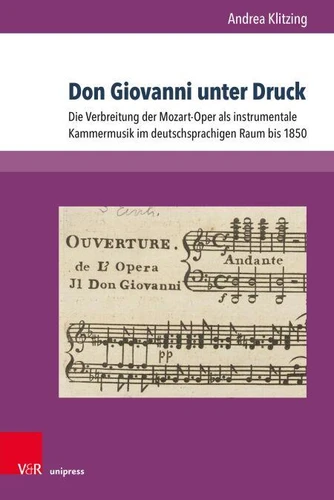
Don Giovanni unter Druck. Die Verbreitung der Mozart-Oper als instrumentale Kammermusik im deutschsprachigen Raum bis 1850
Par :Formats :
Disponible dans votre compte client Decitre ou Furet du Nord dès validation de votre commande. Le format PDF est :
- Compatible avec une lecture sur My Vivlio (smartphone, tablette, ordinateur)
- Compatible avec une lecture sur liseuses Vivlio
- Pour les liseuses autres que Vivlio, vous devez utiliser le logiciel Adobe Digital Edition. Non compatible avec la lecture sur les liseuses Kindle, Remarkable et Sony
 , qui est-ce ?
Notre partenaire de plateforme de lecture numérique où vous retrouverez l'ensemble de vos ebooks gratuitement
Pour en savoir plus sur nos ebooks, consultez notre aide en ligne ici
C'est si simple ! Lisez votre ebook avec l'app Vivlio sur votre tablette, mobile ou ordinateur :

- Nombre de pages299
- FormatPDF
- ISBN978-3-8470-1191-0
- EAN9783847011910
- Date de parution10/08/2020
- Protection num.pas de protection
- Taille8 Mo
- Infos supplémentairespdf
- ÉditeurV&R Unipress
Résumé
Der Band hält innovative Erkenntnisse für die Musikforschung bereit, kann er doch zeigen, dass die frühste Form der Aneignung des »Don Giovanni« durch breite Bevölkerungsschichten die Kammermusik-Bearbeitung war. Aber wie genau gestalten sich diese Rezeptionsstrategien? Wie war das gedruckte Notenmaterial beschaffen, auf dem sie beruhten, und auf welche Weise wurden sie in den begleitenden historischen Periodika und in der Literatur bewertet? Diesen und anderen Fragen geht die Autorin durch ihre multiperspektivischen Betrachtungen auf den Grund: So vereint sie die Untersuchung von 309 bis 1850 erschienenen Kammermusikversionen, welche in einer digitalen Online-Tabelle zusammengefasst sind, mit einer qualitativen Bewertung einzelner Ausgaben, für welche Schriften von E.
T. A. Hoffmann, Ludwig Rellstab und Robert Schumann herangezogen werden. This volume gives innovative insights in music historiography since it can depict that the earliest form of the adaptation of »Don Giovanni« by a wide audience was a chamber music adaptation. However, how are these reception strategies designed? How were the original printed note materials and how were they valued in the accompanied historical periodicals and literature? The author answers these and other questions with the help of her multi-perspective methods.
Thus, she links the analysis of chamber music versions dated from 309 until 1850, summarised in a digital online-table, with a qualitative evaluation of several issues, by referring to writings from E. T. A. Hoffmann, Ludwig Rellstab and Robert Schumann.
T. A. Hoffmann, Ludwig Rellstab und Robert Schumann herangezogen werden. This volume gives innovative insights in music historiography since it can depict that the earliest form of the adaptation of »Don Giovanni« by a wide audience was a chamber music adaptation. However, how are these reception strategies designed? How were the original printed note materials and how were they valued in the accompanied historical periodicals and literature? The author answers these and other questions with the help of her multi-perspective methods.
Thus, she links the analysis of chamber music versions dated from 309 until 1850, summarised in a digital online-table, with a qualitative evaluation of several issues, by referring to writings from E. T. A. Hoffmann, Ludwig Rellstab and Robert Schumann.