
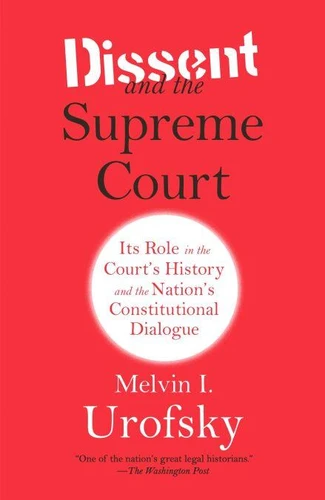
Dissent and the Supreme Court. Its Role in the Court's History and the Nation's Constitutional Dialogue
Par :Formats :
Disponible dans votre compte client Decitre ou Furet du Nord dès validation de votre commande. Le format ePub protégé est :
- Compatible avec une lecture sur My Vivlio (smartphone, tablette, ordinateur)
- Compatible avec une lecture sur liseuses Vivlio
- Pour les liseuses autres que Vivlio, vous devez utiliser le logiciel Adobe Digital Edition. Non compatible avec la lecture sur les liseuses Kindle, Remarkable et Sony
- Non compatible avec un achat hors France métropolitaine
 , qui est-ce ?
Notre partenaire de plateforme de lecture numérique où vous retrouverez l'ensemble de vos ebooks gratuitement
Pour en savoir plus sur nos ebooks, consultez notre aide en ligne ici
C'est si simple ! Lisez votre ebook avec l'app Vivlio sur votre tablette, mobile ou ordinateur :

- Nombre de pages544
- FormatePub
- ISBN978-1-101-87063-1
- EAN9781101870631
- Date de parution13/10/2015
- Protection num.Adobe DRM
- Taille35 Mo
- Infos supplémentairesepub
- ÉditeurSchocken
Résumé
"Highly illuminating ... for anyone interested in the Constitution, the Supreme Court, and the American democracy, lawyer and layperson alike." -The Los Angeles Review of BooksIn his major work, acclaimed historian and judicial authority Melvin Urofsky examines the great dissents throughout the Court's long history. Constitutional dialogue is one of the ways in which we as a people reinvent and reinvigorate our democratic society. The Supreme Court has interpreted the meaning of the Constitution, acknowledged that the Court's majority opinions have not always been right, and initiated a critical discourse about what a particular decision should mean before fashioning subsequent decisions-largely through the power of dissent.
Urofsky shows how the practice grew slowly but steadily, beginning with the infamous and now overturned case of Dred Scott v. Sandford (1857) during which Chief Justice Roger Taney's opinion upheld slavery and ending with the present age of incivility, in which reasoned dialogue seems less and less possible. Dissent on the court and off, Urofsky argues in this major work, has been a crucial ingredient in keeping the Constitution alive and must continue to be so.
Urofsky shows how the practice grew slowly but steadily, beginning with the infamous and now overturned case of Dred Scott v. Sandford (1857) during which Chief Justice Roger Taney's opinion upheld slavery and ending with the present age of incivility, in which reasoned dialogue seems less and less possible. Dissent on the court and off, Urofsky argues in this major work, has been a crucial ingredient in keeping the Constitution alive and must continue to be so.
A propos de Melvin I. Urofsky
14,91 €