
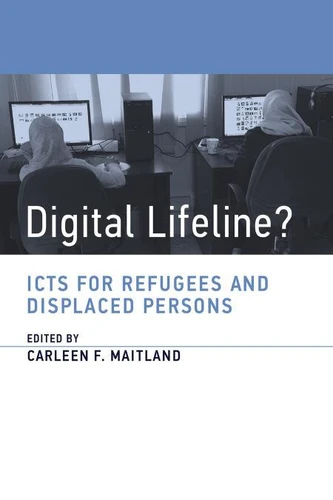
Digital Lifeline?. ICTs for Refugees and Displaced Persons
Par :Formats :
Disponible dans votre compte client Decitre ou Furet du Nord dès validation de votre commande. Le format ePub protégé est :
- Compatible avec une lecture sur My Vivlio (smartphone, tablette, ordinateur)
- Compatible avec une lecture sur liseuses Vivlio
- Pour les liseuses autres que Vivlio, vous devez utiliser le logiciel Adobe Digital Edition. Non compatible avec la lecture sur les liseuses Kindle, Remarkable et Sony
- Non compatible avec un achat hors France métropolitaine
 , qui est-ce ?
Notre partenaire de plateforme de lecture numérique où vous retrouverez l'ensemble de vos ebooks gratuitement
Pour en savoir plus sur nos ebooks, consultez notre aide en ligne ici
C'est si simple ! Lisez votre ebook avec l'app Vivlio sur votre tablette, mobile ou ordinateur :

- Nombre de pages304
- FormatePub
- ISBN978-0-262-34620-7
- EAN9780262346207
- Date de parution04/05/2018
- Protection num.Adobe DRM
- Taille10 Mo
- Infos supplémentairesepub
- ÉditeurThe MIT Press
Résumé
Interdisciplinary perspectives on the role of new information technologies, including mobile phones, wireless networks, and biometric identification, in the global refugee crisis. Today's global refugee crisis has mobilized humanitarian efforts to help those fleeing persecution and armed conflict at all stages of their journey. Aid organizations are increasingly employing new information technologies in their mission, taking advantage of proliferating mobile phones, remote sensors, wireless networks, and biometric identification systems.
Digital Lifeline? examines the use of these technological innovations by the humanitarian community, exploring operations and systems that range from forecasting refugee flows to providing cellular and Internet connectivity to displaced persons. The contributors, from disciplines as diverse as international law and computer science, offer a variety of perspectives on forced migration, technical development, and user behavior, drawing on field work in countries including Jordan, Lebanon, Rwanda, Germany, Greece, the United States, and Canada.
The chapters consider such topics as the use of information technology in refugee status determination; ethical and legal issues surrounding biometric technologies; information technology within organizational hierarchies; the use of technology by refugees; access issues in refugee camps; the scalability and sustainability of information technology innovations in humanitarian work; geographic information systems and spatial thinking; and the use of "big data" analytic techniques.
Finally, the book identifies policy research directions, develops a unified research agenda, and offers practical suggestions for conducting displacement research. ContributorsElizabeth Belding, Karen E. Fisher, Daniel Iland, Lindsey N. Kingston, Carleen F. Maitland, Susan F. Martin, Galya Ben-Arieh Ruffer, Paul Schmitt, Lisa Singh, Brian Tomaszewski, Mariya Zheleva
Digital Lifeline? examines the use of these technological innovations by the humanitarian community, exploring operations and systems that range from forecasting refugee flows to providing cellular and Internet connectivity to displaced persons. The contributors, from disciplines as diverse as international law and computer science, offer a variety of perspectives on forced migration, technical development, and user behavior, drawing on field work in countries including Jordan, Lebanon, Rwanda, Germany, Greece, the United States, and Canada.
The chapters consider such topics as the use of information technology in refugee status determination; ethical and legal issues surrounding biometric technologies; information technology within organizational hierarchies; the use of technology by refugees; access issues in refugee camps; the scalability and sustainability of information technology innovations in humanitarian work; geographic information systems and spatial thinking; and the use of "big data" analytic techniques.
Finally, the book identifies policy research directions, develops a unified research agenda, and offers practical suggestions for conducting displacement research. ContributorsElizabeth Belding, Karen E. Fisher, Daniel Iland, Lindsey N. Kingston, Carleen F. Maitland, Susan F. Martin, Galya Ben-Arieh Ruffer, Paul Schmitt, Lisa Singh, Brian Tomaszewski, Mariya Zheleva