
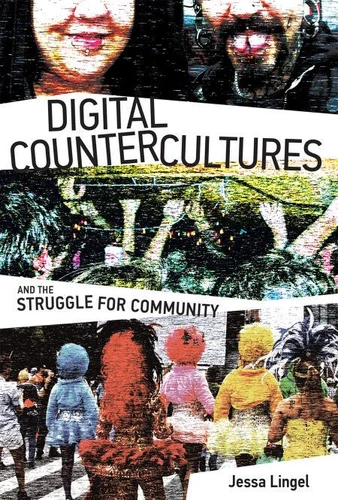
Digital Countercultures and the Struggle for Community
Par :Formats :
Disponible dans votre compte client Decitre ou Furet du Nord dès validation de votre commande. Le format ePub protégé est :
- Compatible avec une lecture sur My Vivlio (smartphone, tablette, ordinateur)
- Compatible avec une lecture sur liseuses Vivlio
- Pour les liseuses autres que Vivlio, vous devez utiliser le logiciel Adobe Digital Edition. Non compatible avec la lecture sur les liseuses Kindle, Remarkable et Sony
- Non compatible avec un achat hors France métropolitaine
 , qui est-ce ?
Notre partenaire de plateforme de lecture numérique où vous retrouverez l'ensemble de vos ebooks gratuitement
Pour en savoir plus sur nos ebooks, consultez notre aide en ligne ici
C'est si simple ! Lisez votre ebook avec l'app Vivlio sur votre tablette, mobile ou ordinateur :

- Nombre de pages192
- FormatePub
- ISBN978-0-262-34016-8
- EAN9780262340168
- Date de parution07/04/2017
- Protection num.Adobe DRM
- Taille2 Mo
- Infos supplémentairesepub
- ÉditeurThe MIT Press
Résumé
How countercultural communities have made the Internet meet their needs, subverting established norms of digital technology use. Whether by accidental keystroke or deliberate tinkering, technology is often used in ways that are unintended and unimagined by its designers and inventors. In this book, Jessa Lingel offers an account of digital technology use that looks beyond Silicon Valley and college dropouts-turned-entrepreneurs.
Instead, Lingel tells stories from the margins of countercultural communities that have made the Internet meet their needs, subverting established norms of how digital technologies should be used. Lingel presents three case studies that contrast the imagined uses of the web to its lived and often messy practicalities. She examines a social media platform (developed long before Facebook) for body modification enthusiasts, with early web experiments in blogging, community, wikis, online dating, and podcasts; a network of communication technologies (both analog and digital) developed by a local community of punk rockers to manage information about underground shows; and the use of Facebook and Instagram for both promotional and community purposes by Brooklyn drag queens.
Drawing on years of fieldwork, Lingel explores issues of alterity and community, inclusivity and exclusivity, secrecy and surveillance, and anonymity and self-promotion. By examining online life in terms of countercultural communities, Lingel argues that looking at outsider experiences helps us to imagine new uses and possibilities for the tools and platforms we use in everyday life.
Instead, Lingel tells stories from the margins of countercultural communities that have made the Internet meet their needs, subverting established norms of how digital technologies should be used. Lingel presents three case studies that contrast the imagined uses of the web to its lived and often messy practicalities. She examines a social media platform (developed long before Facebook) for body modification enthusiasts, with early web experiments in blogging, community, wikis, online dating, and podcasts; a network of communication technologies (both analog and digital) developed by a local community of punk rockers to manage information about underground shows; and the use of Facebook and Instagram for both promotional and community purposes by Brooklyn drag queens.
Drawing on years of fieldwork, Lingel explores issues of alterity and community, inclusivity and exclusivity, secrecy and surveillance, and anonymity and self-promotion. By examining online life in terms of countercultural communities, Lingel argues that looking at outsider experiences helps us to imagine new uses and possibilities for the tools and platforms we use in everyday life.