
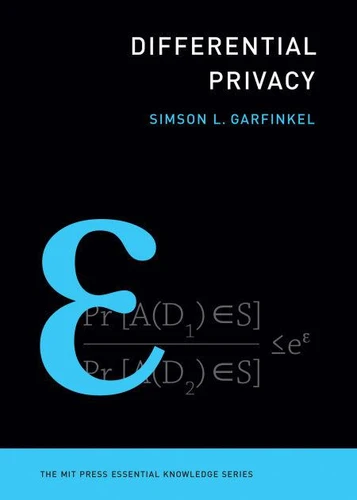
Differential Privacy
Par :Formats :
Disponible dans votre compte client Decitre ou Furet du Nord dès validation de votre commande. Le format ePub protégé est :
- Compatible avec une lecture sur My Vivlio (smartphone, tablette, ordinateur)
- Compatible avec une lecture sur liseuses Vivlio
- Pour les liseuses autres que Vivlio, vous devez utiliser le logiciel Adobe Digital Edition. Non compatible avec la lecture sur les liseuses Kindle, Remarkable et Sony
- Non compatible avec un achat hors France métropolitaine
 , qui est-ce ?
Notre partenaire de plateforme de lecture numérique où vous retrouverez l'ensemble de vos ebooks gratuitement
Pour en savoir plus sur nos ebooks, consultez notre aide en ligne ici
C'est si simple ! Lisez votre ebook avec l'app Vivlio sur votre tablette, mobile ou ordinateur :

- Nombre de pages244
- FormatePub
- ISBN978-0-262-38217-5
- EAN9780262382175
- Date de parution25/03/2025
- Protection num.Adobe DRM
- Taille2 Mo
- Infos supplémentairesepub
- ÉditeurThe MIT Press
Résumé
A robust yet accessible introduction to the idea, history, and key applications of differential privacy-the gold standard of algorithmic privacy protection. Differential privacy (DP) is an increasingly popular, though controversial, approach to protecting personal data. DP protects confidential data by introducing carefully calibrated random numbers, called statistical noise, when the data is used.
Google, Apple, and Microsoft have all integrated the technology into their software, and the US Census Bureau used DP to protect data collected in the 2020 census. In this book, Simson Garfinkel presents the underlying ideas of DP, and helps explain why DP is needed in today's information-rich environment, why it was used as the privacy protection mechanism for the 2020 census, and why it is so controversial in some communities.
When DP is used to protect confidential data, like an advertising profile based on the web pages you have viewed with a web browser, the noise makes it impossible for someone to take that profile and reverse engineer, with absolute certainty, the underlying confidential data on which the profile was computed. The book also chronicles the history of DP and describes the key participants and its limitations.
Along the way, it also presents a short history of the US Census and other approaches for data protection such as de-identification and k-anonymity.
Google, Apple, and Microsoft have all integrated the technology into their software, and the US Census Bureau used DP to protect data collected in the 2020 census. In this book, Simson Garfinkel presents the underlying ideas of DP, and helps explain why DP is needed in today's information-rich environment, why it was used as the privacy protection mechanism for the 2020 census, and why it is so controversial in some communities.
When DP is used to protect confidential data, like an advertising profile based on the web pages you have viewed with a web browser, the noise makes it impossible for someone to take that profile and reverse engineer, with absolute certainty, the underlying confidential data on which the profile was computed. The book also chronicles the history of DP and describes the key participants and its limitations.
Along the way, it also presents a short history of the US Census and other approaches for data protection such as de-identification and k-anonymity.