
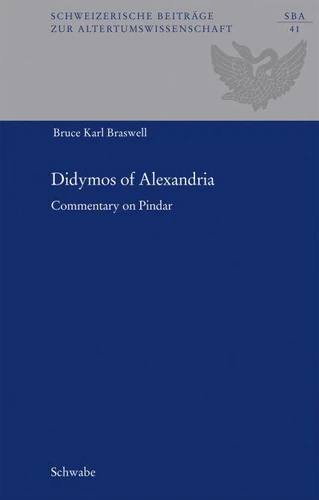
Didymos of Alexandria. Commentary on Pindar
Par : ,Formats :
Disponible dans votre compte client Decitre ou Furet du Nord dès validation de votre commande. Le format PDF protégé est :
- Compatible avec une lecture sur My Vivlio (smartphone, tablette, ordinateur)
- Compatible avec une lecture sur liseuses Vivlio
- Pour les liseuses autres que Vivlio, vous devez utiliser le logiciel Adobe Digital Edition. Non compatible avec la lecture sur les liseuses Kindle, Remarkable et Sony
- Non compatible avec un achat hors France métropolitaine
 , qui est-ce ?
Notre partenaire de plateforme de lecture numérique où vous retrouverez l'ensemble de vos ebooks gratuitement
Pour en savoir plus sur nos ebooks, consultez notre aide en ligne ici
C'est si simple ! Lisez votre ebook avec l'app Vivlio sur votre tablette, mobile ou ordinateur :

- Nombre de pages325
- FormatPDF
- ISBN978-3-7965-3493-5
- EAN9783796534935
- Date de parution30/06/2017
- Protection num.Adobe DRM
- Taille5 Mo
- Infos supplémentairespdf
- ÉditeurSchwabe & Co
Résumé
Modern studies of Pindar have largely neglected ancient scholarship on the poet. This is not entirely by chance, since the almost 1000 pages of the scholia vetera on the odes presuppose an acquaintance with the language and conventions of the Hellenistic grammarians who commented on the Pindaric texts. While the scholia have not undeservedly been criticized for containing a sizeable amount of dross, they have nevertheless preserved the comments of major figures of Alexandrian scholarship such as Aristarchos and Didymos whose interpretations are not only of historical interest but can often contribute to a better understanding of ancient texts.
The Pindaric scholarship of Aristarchos was the subject of two special studies, both of which appeared as long ago as 1883, while Didymos has fared even less well. The only collection of the remains of his Pindar commentary was published by Moritz Schmidt in his 1854 edition of all the fragments of the grammarian known to him. This was based on Boeckh's partial edition of the Pindar scholia published in 1819.
The present edition, which draws on Drachmann's critical edition, not only offers a revised Greek text but also an English translation with explanatory notes and full indices. An extensive introduction, which situates Didymos in the scholarship of late Ptolemaic Alexandria, includes the first modern critical catalogue of all the works which are expressly attributed to him. While the present work is primarily addressed to advanced students and professional classicists, it is hoped that the presentation will ease the entry of others into the fascinating field of ancient scholarship which has now established itself as a special discipline.
The Pindaric scholarship of Aristarchos was the subject of two special studies, both of which appeared as long ago as 1883, while Didymos has fared even less well. The only collection of the remains of his Pindar commentary was published by Moritz Schmidt in his 1854 edition of all the fragments of the grammarian known to him. This was based on Boeckh's partial edition of the Pindar scholia published in 1819.
The present edition, which draws on Drachmann's critical edition, not only offers a revised Greek text but also an English translation with explanatory notes and full indices. An extensive introduction, which situates Didymos in the scholarship of late Ptolemaic Alexandria, includes the first modern critical catalogue of all the works which are expressly attributed to him. While the present work is primarily addressed to advanced students and professional classicists, it is hoped that the presentation will ease the entry of others into the fascinating field of ancient scholarship which has now established itself as a special discipline.