SOLDES
Jusqu'à -70% sur une sélection d'articles*

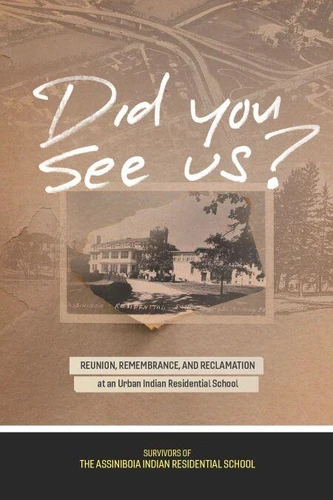
Did You See Us?. Reunion, Remembrance, and Reclamation at an Urban Indian Residential School
Par :Formats :
Disponible dans votre compte client Decitre ou Furet du Nord dès validation de votre commande. Le format ePub est :
- Compatible avec une lecture sur My Vivlio (smartphone, tablette, ordinateur)
- Compatible avec une lecture sur liseuses Vivlio
- Pour les liseuses autres que Vivlio, vous devez utiliser le logiciel Adobe Digital Edition. Non compatible avec la lecture sur les liseuses Kindle, Remarkable et Sony
 , qui est-ce ?
Notre partenaire de plateforme de lecture numérique où vous retrouverez l'ensemble de vos ebooks gratuitement
Pour en savoir plus sur nos ebooks, consultez notre aide en ligne ici
C'est si simple ! Lisez votre ebook avec l'app Vivlio sur votre tablette, mobile ou ordinateur :

- Nombre de pages272
- FormatePub
- ISBN978-0-88755-920-4
- EAN9780887559204
- Date de parution19/03/2021
- Protection num.Digital Watermarking
- Taille7 Mo
- Infos supplémentairesepub
- ÉditeurUniversity of Manitoba Press
Résumé
WINNER Mary Scorer Award for Best Book by a Manitoba Publisher (2022)
The Assiniboia school is unique within Canada's Indian Residential School system. It was the first residential high school in Manitoba and one of the only residential schools in Canada to be located in a large urban setting. Operating between 1958 and 1973 in a period when the residential school system was in decline, it produced several future leaders, artists, educators, knowledge keepers, and other notable figures.
It was in many ways an experiment within the broader destructive framework of Canadian residential schools. Stitching together memories of arrival at, day-to-day life within, and departure from the school with a socio-historical reconstruction of the school and its position in both Winnipeg and the larger residential school system, Did You See Us? offers a glimpse of Assiniboia that is not available in the archival records.
It connects readers with a specific residential school and illustrates that residential schools were often complex spaces where forced assimilation and Indigenous resilience co-existed. These recollections of Assiniboia at times diverge, but together exhibit Survivor resilience and the strength of the relationships that bond them to this day. The volume captures the troubled history of residential schools.
At the same time, it invites the reader to join in a reunion of sorts, entered into through memories and images of students, staff, and neighbours. It is a gathering of diverse knowledges juxtaposed to communicate the complexity of the residential school experience.
It was in many ways an experiment within the broader destructive framework of Canadian residential schools. Stitching together memories of arrival at, day-to-day life within, and departure from the school with a socio-historical reconstruction of the school and its position in both Winnipeg and the larger residential school system, Did You See Us? offers a glimpse of Assiniboia that is not available in the archival records.
It connects readers with a specific residential school and illustrates that residential schools were often complex spaces where forced assimilation and Indigenous resilience co-existed. These recollections of Assiniboia at times diverge, but together exhibit Survivor resilience and the strength of the relationships that bond them to this day. The volume captures the troubled history of residential schools.
At the same time, it invites the reader to join in a reunion of sorts, entered into through memories and images of students, staff, and neighbours. It is a gathering of diverse knowledges juxtaposed to communicate the complexity of the residential school experience.
A propos de Andrew Woolford
16,99 €