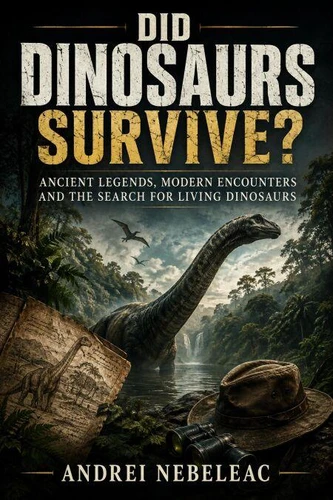
What if the dinosaurs did not completely disappear 66 million years ago?Science tells us that non-avian dinosaurs vanished during the catastrophic Cretaceous-Paleogene extinction. But determining exactly when the final population of a species disappeared is far more difficult than identifying its youngest known fossil. Did Dinosaurs Survive? investigates one of the most fascinating possibilities in natural history: could isolated populations of recognizable dinosaurs have survived far beyond the accepted extinction boundary-and perhaps even into the age of humans?From the fossil record and the Signor-Lipps effect to remote rainforests, enormous swamps and unexplored ecosystems, this book examines what would actually be required for a dinosaur population to remain hidden.
The investigation then enters more controversial territory: ancient dragon traditions, mysterious historical accounts, indigenous stories of enormous reptiles, Mokele-mbembe and other African cryptids, alleged prehistoric creatures of the Amazon, reports of living pterosaurs in Papua New Guinea, modern eyewitness encounters, mysterious footprints, photographs and disputed physical evidence. Could ancient dragon legends have originated from fossil discoveries? Could known animals such as crocodiles, giant snakes and monitor lizards explain supposedly prehistoric creatures? How reliable are modern eyewitness accounts? And in an age of satellites, drones, camera traps and environmental DNA, could a population of large unknown animals still escape scientific detection?The book examines both the extraordinary claims and the scientific arguments against them.
It does not present legends or cryptozoological reports as established fact. Instead, it asks what evidence exists, what alternative explanations are possible, and what kind of discovery would finally constitute proof. If even one lineage of non-avian dinosaurs survived, where would we look for it-and what evidence should we expect to find?
What if the dinosaurs did not completely disappear 66 million years ago?Science tells us that non-avian dinosaurs vanished during the catastrophic Cretaceous-Paleogene extinction. But determining exactly when the final population of a species disappeared is far more difficult than identifying its youngest known fossil. Did Dinosaurs Survive? investigates one of the most fascinating possibilities in natural history: could isolated populations of recognizable dinosaurs have survived far beyond the accepted extinction boundary-and perhaps even into the age of humans?From the fossil record and the Signor-Lipps effect to remote rainforests, enormous swamps and unexplored ecosystems, this book examines what would actually be required for a dinosaur population to remain hidden.
The investigation then enters more controversial territory: ancient dragon traditions, mysterious historical accounts, indigenous stories of enormous reptiles, Mokele-mbembe and other African cryptids, alleged prehistoric creatures of the Amazon, reports of living pterosaurs in Papua New Guinea, modern eyewitness encounters, mysterious footprints, photographs and disputed physical evidence. Could ancient dragon legends have originated from fossil discoveries? Could known animals such as crocodiles, giant snakes and monitor lizards explain supposedly prehistoric creatures? How reliable are modern eyewitness accounts? And in an age of satellites, drones, camera traps and environmental DNA, could a population of large unknown animals still escape scientific detection?The book examines both the extraordinary claims and the scientific arguments against them.
It does not present legends or cryptozoological reports as established fact. Instead, it asks what evidence exists, what alternative explanations are possible, and what kind of discovery would finally constitute proof. If even one lineage of non-avian dinosaurs survived, where would we look for it-and what evidence should we expect to find?