
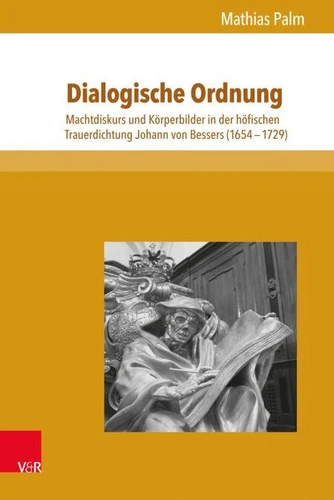
Dialogische Ordnung. Machtdiskurs und Körperbilder in der höfischen Trauerdichtung Johann von Bessers (1654–1729)
Par : , , , ,Formats :
Disponible dans votre compte client Decitre ou Furet du Nord dès validation de votre commande. Le format PDF est :
- Compatible avec une lecture sur My Vivlio (smartphone, tablette, ordinateur)
- Compatible avec une lecture sur liseuses Vivlio
- Pour les liseuses autres que Vivlio, vous devez utiliser le logiciel Adobe Digital Edition. Non compatible avec la lecture sur les liseuses Kindle, Remarkable et Sony
 , qui est-ce ?
Notre partenaire de plateforme de lecture numérique où vous retrouverez l'ensemble de vos ebooks gratuitement
Pour en savoir plus sur nos ebooks, consultez notre aide en ligne ici
C'est si simple ! Lisez votre ebook avec l'app Vivlio sur votre tablette, mobile ou ordinateur :

- Nombre de pages204
- FormatPDF
- ISBN978-3-8470-0221-5
- EAN9783847002215
- Date de parution12/03/2014
- Protection num.pas de protection
- Taille1 Mo
- Infos supplémentairespdf
- ÉditeurV&R Unipress
Résumé
Am Beispiel ausgewählter Trostschriften des brandenburg-preußischen Oberzeremonienmeisters Johann von Besser widmet sich Mathias Palms Studie der paradigmatischen Ausprägung des Dialogischen in der Literatur der Frühen Neuzeit. Das dialogische Paradigma der Arbeit orientiert sich an den höfisch-sozialen Kategorien Zeremoniell und Repräsentation. Auf der medialen Ebene behandelt ein ebenso dialogisch konzipiertes Machtdispositiv diese soziale Verfasstheit als Teil eines Herrschaftsdiskurses sowie als Mittel der Partizipation und der Legitimation.
Die Vermittlung erfolgt insbesondere über die Motivik von Körperbildern als soziales bzw. physisches Gebilde. Die Epicedien sind Steuerungsmedien und Indikatoren politischen bzw. höfischen Verhaltens und verweisen über die Vermittlung der Körperbilder auf jeweils intendierte Machtkonstellationen, die so für die Systemstabilisierung und Sozialdisziplinierung in der höfischen Welt sorgen. Based on examples of selected writings of consolation by Johann von Besser, Supreme Master of Ceremonies of Brandenburg-Prussia, Mathias Palm's study addresses the paradigmatic form of dialogue in early modern literature.
Setting out from a model of the general connection between norms and deviation, the dialogical paradigm of the study is oriented to the courtly social categories of ceremony and representation. At the media level a dialogically conceived dispositive of power treats this social constitutiveness as a part of a discourse of power and a means of participation and legitimation. The message is mediated in particular through body images representing social or physical structures.
Besser's Epicedia, or funeral sermons, have a regulatory effect, functioning as indicators of political, or courtly, behaviour and pointing to intended power constellations through the body images, thus ensuring the stability of the system and social discipline in the courtly world.
Die Vermittlung erfolgt insbesondere über die Motivik von Körperbildern als soziales bzw. physisches Gebilde. Die Epicedien sind Steuerungsmedien und Indikatoren politischen bzw. höfischen Verhaltens und verweisen über die Vermittlung der Körperbilder auf jeweils intendierte Machtkonstellationen, die so für die Systemstabilisierung und Sozialdisziplinierung in der höfischen Welt sorgen. Based on examples of selected writings of consolation by Johann von Besser, Supreme Master of Ceremonies of Brandenburg-Prussia, Mathias Palm's study addresses the paradigmatic form of dialogue in early modern literature.
Setting out from a model of the general connection between norms and deviation, the dialogical paradigm of the study is oriented to the courtly social categories of ceremony and representation. At the media level a dialogically conceived dispositive of power treats this social constitutiveness as a part of a discourse of power and a means of participation and legitimation. The message is mediated in particular through body images representing social or physical structures.
Besser's Epicedia, or funeral sermons, have a regulatory effect, functioning as indicators of political, or courtly, behaviour and pointing to intended power constellations through the body images, thus ensuring the stability of the system and social discipline in the courtly world.