SOLDES
Jusqu'à -70% sur une sélection d'articles*

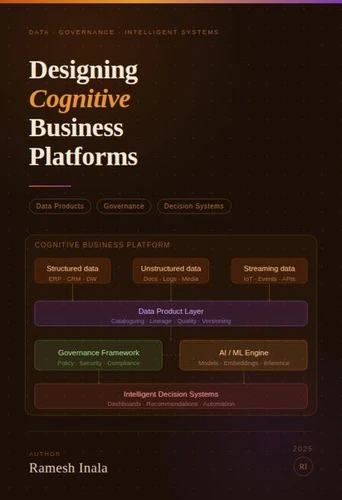
Designing Cognitive Business Platforms: Data Products, Governance, and Intelligent Decision Systems
Par : ,Formats :
Disponible dans votre compte client Decitre ou Furet du Nord dès validation de votre commande. Le format ePub est :
- Compatible avec une lecture sur My Vivlio (smartphone, tablette, ordinateur)
- Compatible avec une lecture sur liseuses Vivlio
- Pour les liseuses autres que Vivlio, vous devez utiliser le logiciel Adobe Digital Edition. Non compatible avec la lecture sur les liseuses Kindle, Remarkable et Sony
 , qui est-ce ?
Notre partenaire de plateforme de lecture numérique où vous retrouverez l'ensemble de vos ebooks gratuitement
Pour en savoir plus sur nos ebooks, consultez notre aide en ligne ici
C'est si simple ! Lisez votre ebook avec l'app Vivlio sur votre tablette, mobile ou ordinateur :

- FormatePub
- ISBN8235661134
- EAN9798235661134
- Date de parution29/03/2026
- Protection num.pas de protection
- Infos supplémentairesepub
- ÉditeurIoakim Ioakim
Résumé
Designing Cognitive Business Platforms: Data Products, Governance, and Intelligent Decision Systems offers a comprehensive exploration of how modern enterprises can harness artificial intelligence, machine learning, and data engineering to build intelligent, scalable, and governed business platforms. Written by Ramesh Inala, this book bridges theory and practice across ten in-depth chapters, each addressing a critical layer of the cognitive enterprise stack.
The book begins by establishing the conceptual foundations of cognitive business platforms, examining their core capabilities, architectural principles, ethical considerations, and regulatory landscape. It then moves into the architecture of enterprise data product ecosystems, explaining how organizations can treat data as a first-class product with defined ownership, lifecycle management, observability, and API-first access models.
Subsequent chapters address data modeling and information architecture strategies, covering conceptual, logical, and physical models, entity-relationship design, normalization, metadata management, taxonomies, and ontologies. Master data management for customer and product intelligence is examined in depth, including identity resolution, customer 360 views, MDM styles such as registry, repository, and coexistence, and product hierarchy design.
A dedicated chapter on data governance and trust frameworks explains how organizations can establish compliance programs, data contracts, auditability, provenance tracking, and interoperability standards across enterprise platforms. Big data infrastructure and scalable processing architectures are covered through batch and stream processing frameworks, distributed file systems, fault tolerance mechanisms, and resource management strategies.
The book explores machine learning systems for business intelligence and prediction, covering data ingestion, model governance, ethics, risk management, and real-world case studies in retail and customer analytics. Intelligent decision systems for financial and protection services are analyzed, including automated risk assessment, fraud detection, public safety, social welfare allocation, and the governance of bias, fairness, and transparency.
Agentic systems and autonomous business operations are examined through the lenses of agency theory, control architectures, human-machine collaboration, accountability, and ethical labor impacts. The final chapter looks at future directions, covering foundation models, federated learning, privacy-preserving analytics, composable platform design, and human-centric AI collaboration. This book is an essential reference for data architects, AI engineers, business intelligence professionals, enterprise architects, and senior leaders seeking to design and govern next-generation cognitive platforms that are trustworthy, scalable, and aligned with both business strategy and regulatory expectations.
The book begins by establishing the conceptual foundations of cognitive business platforms, examining their core capabilities, architectural principles, ethical considerations, and regulatory landscape. It then moves into the architecture of enterprise data product ecosystems, explaining how organizations can treat data as a first-class product with defined ownership, lifecycle management, observability, and API-first access models.
Subsequent chapters address data modeling and information architecture strategies, covering conceptual, logical, and physical models, entity-relationship design, normalization, metadata management, taxonomies, and ontologies. Master data management for customer and product intelligence is examined in depth, including identity resolution, customer 360 views, MDM styles such as registry, repository, and coexistence, and product hierarchy design.
A dedicated chapter on data governance and trust frameworks explains how organizations can establish compliance programs, data contracts, auditability, provenance tracking, and interoperability standards across enterprise platforms. Big data infrastructure and scalable processing architectures are covered through batch and stream processing frameworks, distributed file systems, fault tolerance mechanisms, and resource management strategies.
The book explores machine learning systems for business intelligence and prediction, covering data ingestion, model governance, ethics, risk management, and real-world case studies in retail and customer analytics. Intelligent decision systems for financial and protection services are analyzed, including automated risk assessment, fraud detection, public safety, social welfare allocation, and the governance of bias, fairness, and transparency.
Agentic systems and autonomous business operations are examined through the lenses of agency theory, control architectures, human-machine collaboration, accountability, and ethical labor impacts. The final chapter looks at future directions, covering foundation models, federated learning, privacy-preserving analytics, composable platform design, and human-centric AI collaboration. This book is an essential reference for data architects, AI engineers, business intelligence professionals, enterprise architects, and senior leaders seeking to design and govern next-generation cognitive platforms that are trustworthy, scalable, and aligned with both business strategy and regulatory expectations.