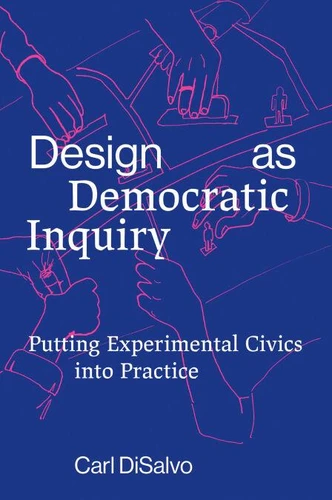
Through practices of collaborative imagination and making, or "doing design otherwise, " design experiments can contribute to keeping local democracies vibrant. In this counterpoint to the grand narratives of design punditry, Carl DiSalvo presents what he calls "doing design otherwise." Arguing that democracy requires constant renewal and care, he shows how designers can supply novel contributions to local democracy by drawing together theory and practice, making and reflection.
The relentless pursuit of innovation, uncritical embrace of the new and novel, and treatment of all things as design problems, says DiSalvo, can lead to cultural imperialism. In Design as Democratic Inquiry, he recounts a series of projects that exemplify engaged design in practice. These experiments in practice-based research are grounded in collaborations with communities and institutions. The projects DiSalvo describes took place from 2014 to 2019 in Atlanta.
Rather than presume that government, industry-or academia-should determine the outcome, the designers began with the recognition that the residents and local organizations were already creative and resourceful. DiSalvo uses the projects to show how design might work as a mode of inquiry. Resisting heroic stories of design and innovation, he argues for embracing design as fragile, contingent, partial, and compromised.
In particular, he explores how design might be leveraged to facilitate a more diverse civic imagination. A fundamental tenet of design is that the world is made, and therefore it could be made differently. A key concept is that democracy requires constant renewal and care. Thus, designing becomes a way to care, together, for our collective future.
Through practices of collaborative imagination and making, or "doing design otherwise, " design experiments can contribute to keeping local democracies vibrant. In this counterpoint to the grand narratives of design punditry, Carl DiSalvo presents what he calls "doing design otherwise." Arguing that democracy requires constant renewal and care, he shows how designers can supply novel contributions to local democracy by drawing together theory and practice, making and reflection.
The relentless pursuit of innovation, uncritical embrace of the new and novel, and treatment of all things as design problems, says DiSalvo, can lead to cultural imperialism. In Design as Democratic Inquiry, he recounts a series of projects that exemplify engaged design in practice. These experiments in practice-based research are grounded in collaborations with communities and institutions. The projects DiSalvo describes took place from 2014 to 2019 in Atlanta.
Rather than presume that government, industry-or academia-should determine the outcome, the designers began with the recognition that the residents and local organizations were already creative and resourceful. DiSalvo uses the projects to show how design might work as a mode of inquiry. Resisting heroic stories of design and innovation, he argues for embracing design as fragile, contingent, partial, and compromised.
In particular, he explores how design might be leveraged to facilitate a more diverse civic imagination. A fundamental tenet of design is that the world is made, and therefore it could be made differently. A key concept is that democracy requires constant renewal and care. Thus, designing becomes a way to care, together, for our collective future.


 , qui est-ce ?
