Dr. Dominika Janus ist wissenschaftliche Mitarbeiterin am Institut für Germanistik der Universität Gdansk, Polen. Sie studierte Polonistik und Germanistik und promovierte 2011 im Bereich Sprachwissenschaft. Ihre Forschungsschwerpunkte sind Textsortenlinguistik, Sprachgeschichte, Phraseologie, Phraseographie und Phraseodidaktik sowie Thanatologie.
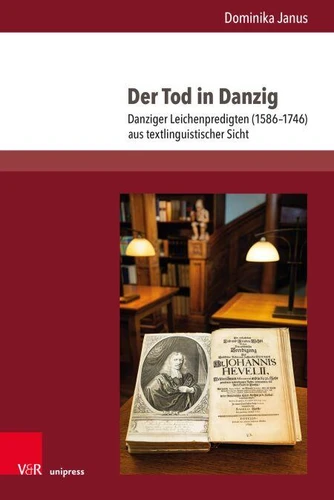
Der Tod in Danzig. Danziger Leichenpredigten (1586–1746) aus textlinguistischer Sicht
Par :Formats :
Disponible dans votre compte client Decitre ou Furet du Nord dès validation de votre commande. Le format PDF est :
- Compatible avec une lecture sur My Vivlio (smartphone, tablette, ordinateur)
- Compatible avec une lecture sur liseuses Vivlio
- Pour les liseuses autres que Vivlio, vous devez utiliser le logiciel Adobe Digital Edition. Non compatible avec la lecture sur les liseuses Kindle, Remarkable et Sony
 , qui est-ce ?
Notre partenaire de plateforme de lecture numérique où vous retrouverez l'ensemble de vos ebooks gratuitement
Pour en savoir plus sur nos ebooks, consultez notre aide en ligne ici
C'est si simple ! Lisez votre ebook avec l'app Vivlio sur votre tablette, mobile ou ordinateur :

- Nombre de pages513
- FormatPDF
- ISBN978-3-8470-1645-8
- EAN9783847016458
- Date de parution04/12/2023
- Protection num.pas de protection
- Taille9 Mo
- Infos supplémentairespdf
- ÉditeurV&R Unipress
Résumé
Im Mittelpunkt von Dominika Janus' Untersuchung steht die pragmatisch ausgerichtete textlinguistische Beschreibung des Textkomplexes >Leichenpredigt<. Räumlich konzentriert sich ihre Analyse auf Danzig, wo es - wie in anderen Reformationsregionen - zur Aus- und Verbreitung des lutherischen Brauches kam, Leichenpredigten zu verfassen und zu drucken. Zeitlich umfasst die Untersuchung die Jahre 1586 bis 1746, aus denen die in der Danziger Bibliothek der Polnischen Akademie der Wissenschaften aufbewahrten Leichenpredigten stammen.
Die Danziger Leichenpredigten, die bisher noch nicht Gegenstand (text-)linguistischer Untersuchungen gewesen sind, wurden einer mehrdimensionalen textologischen Analyse unterzogen, die situative Rahmenbedingungen, Makrostruktur, Funktion, sprachlich-stilistische Gestaltung und Thema umfasst. Dominika Janus' study focuses on a pragmatically oriented text-linguistic description of the text complex 'funeral sermon'.
Spatially, the analysis concentrates on Gdansk, where - as in other Reformation regions - the Lutheran custom of writing and printing funeral sermons developed and spread. The years 1586 to 1746, from which the funeral sermons preserved in the Gdansk Library of the Polish Academy of Sciences, are the focus of the study. The Gdansk funeral sermons, which have not yet been the subject of (text)linguistic studies, were subjected to a multidimensional textological analysis that encompasses situational framework conditions, macrostructure, function, linguistic-stylistic design and theme.
Die Danziger Leichenpredigten, die bisher noch nicht Gegenstand (text-)linguistischer Untersuchungen gewesen sind, wurden einer mehrdimensionalen textologischen Analyse unterzogen, die situative Rahmenbedingungen, Makrostruktur, Funktion, sprachlich-stilistische Gestaltung und Thema umfasst. Dominika Janus' study focuses on a pragmatically oriented text-linguistic description of the text complex 'funeral sermon'.
Spatially, the analysis concentrates on Gdansk, where - as in other Reformation regions - the Lutheran custom of writing and printing funeral sermons developed and spread. The years 1586 to 1746, from which the funeral sermons preserved in the Gdansk Library of the Polish Academy of Sciences, are the focus of the study. The Gdansk funeral sermons, which have not yet been the subject of (text)linguistic studies, were subjected to a multidimensional textological analysis that encompasses situational framework conditions, macrostructure, function, linguistic-stylistic design and theme.