SOLDES
Jusqu'à -70% sur une sélection d'articles*

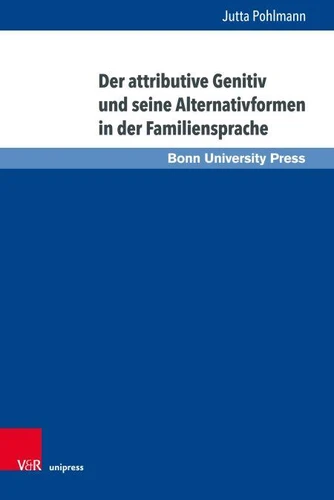
Der attributive Genitiv und seine Alternativformen in der Familiensprache
Par :Formats :
Disponible dans votre compte client Decitre ou Furet du Nord dès validation de votre commande. Le format PDF est :
- Compatible avec une lecture sur My Vivlio (smartphone, tablette, ordinateur)
- Compatible avec une lecture sur liseuses Vivlio
- Pour les liseuses autres que Vivlio, vous devez utiliser le logiciel Adobe Digital Edition. Non compatible avec la lecture sur les liseuses Kindle, Remarkable et Sony
 , qui est-ce ?
Notre partenaire de plateforme de lecture numérique où vous retrouverez l'ensemble de vos ebooks gratuitement
Pour en savoir plus sur nos ebooks, consultez notre aide en ligne ici
C'est si simple ! Lisez votre ebook avec l'app Vivlio sur votre tablette, mobile ou ordinateur :

- Nombre de pages222
- FormatPDF
- ISBN978-3-8470-0967-2
- EAN9783847009672
- Date de parution15/04/2019
- Protection num.pas de protection
- Taille2 Mo
- Infos supplémentairespdf
- ÉditeurV&R Unipress
Résumé
Der attributive Genitiv wird gemeinhin als rein schrift- und standardsprachliches Phänomen untersucht. Seine Alternativformen, das Präpositional- und das Dativattribut, gelten als die mündlich verwendeten Pendants. Aber wie manifestiert sich der Genitiv in der gesprochenen Sprache? Gibt es Regeln, nach denen Sprecherinnen und Sprecher bestimmte Attribute favorisieren oder handelt es sich bei der Wahl um eine nicht nachvollziehbare Eigenlogik? Als Grundlage der Beantwortung dieser Fragen verwendet Jutta Pohlmann erstmals die Familiensprache und untersucht ein eigens für die Anforderungen der Studie erstelltes Korpus.
Bei der Auswertung zeigt sich, dass sich die Verwendungsweise der Attribute in äußerst komplexer Weise auf den jeweiligen Bedarf ausrichtet. The German adnominal genitive is commonly studied as a phenomenon in written language and in the standard variety. Its alternative constructions, the 'von'-construction and the adnominal dative, are considered to be the orally used counterparts. But how is the adnominal genitive used in spoken language? Are there rules, speakers use unconsciously and thus prefer certain attributes, or is 'the choice' an incomprehensible internal logic? As the basis for answering these questions, the family language is used for the first time and a corpus is created specifically for the requirements of the study.
The analysis reveals that the way in which the attributes are used is very complex and tailored to specific needs.
Bei der Auswertung zeigt sich, dass sich die Verwendungsweise der Attribute in äußerst komplexer Weise auf den jeweiligen Bedarf ausrichtet. The German adnominal genitive is commonly studied as a phenomenon in written language and in the standard variety. Its alternative constructions, the 'von'-construction and the adnominal dative, are considered to be the orally used counterparts. But how is the adnominal genitive used in spoken language? Are there rules, speakers use unconsciously and thus prefer certain attributes, or is 'the choice' an incomprehensible internal logic? As the basis for answering these questions, the family language is used for the first time and a corpus is created specifically for the requirements of the study.
The analysis reveals that the way in which the attributes are used is very complex and tailored to specific needs.