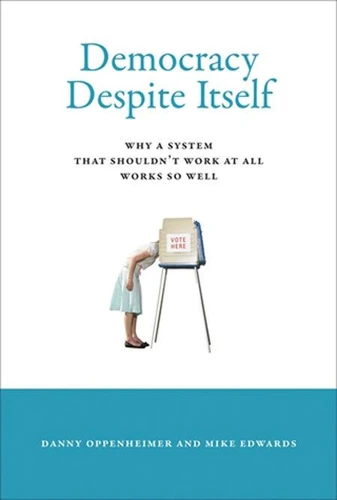
Democracy Despite Itself. Why a System That Shouldn't Work at All Works So Well
Par : ,Formats :
Disponible dans votre compte client Decitre ou Furet du Nord dès validation de votre commande. Le format ePub protégé est :
- Compatible avec une lecture sur My Vivlio (smartphone, tablette, ordinateur)
- Compatible avec une lecture sur liseuses Vivlio
- Pour les liseuses autres que Vivlio, vous devez utiliser le logiciel Adobe Digital Edition. Non compatible avec la lecture sur les liseuses Kindle, Remarkable et Sony
- Non compatible avec un achat hors France métropolitaine
 , qui est-ce ?
Notre partenaire de plateforme de lecture numérique où vous retrouverez l'ensemble de vos ebooks gratuitement
Pour en savoir plus sur nos ebooks, consultez notre aide en ligne ici
C'est si simple ! Lisez votre ebook avec l'app Vivlio sur votre tablette, mobile ou ordinateur :

- Nombre de pages256
- FormatePub
- ISBN978-0-262-30095-7
- EAN9780262300957
- Date de parution27/01/2012
- Protection num.Adobe DRM
- Taille1 Mo
- Infos supplémentairesepub
- ÉditeurThe MIT Press
Résumé
Why democracy is the most effective form of government despite irrational (and sometime oblivious) voters and flawed (and sometimes inept) politicians. Voters often make irrational decisions based on inaccurate and irrelevant information. Politicians are often inept, corrupt, or out of touch with the will of the people. Elections can be determined by the design of the ballot and the gerrymandered borders of a district.
And yet, despite voters who choose candidates according to the boxer-brief dichotomy and politicians who struggle to put together a coherent sentence, democracy works exceptionally well: citizens of democracies are healthier, happier, and freer than citizens of other countries. In Democracy Despite Itself, Danny Oppenheimer, a psychologist, and Mike Edwards, a political scientist, explore this paradox: How can democracy lead to such successful outcomes when the defining characteristic of democracy-elections-is so flawed?Oppenheimer and Edwards argue that democracy works because regular elections, no matter how flawed, produce a variety of unintuitive, positive consequences.
The brilliance of democracy, write Oppenheimer and Edwards, does not lie in the people's ability to pick superior leaders. It lies in the many ways that it subtly encourages the flawed people and their flawed leaders to work toward building a better society.
And yet, despite voters who choose candidates according to the boxer-brief dichotomy and politicians who struggle to put together a coherent sentence, democracy works exceptionally well: citizens of democracies are healthier, happier, and freer than citizens of other countries. In Democracy Despite Itself, Danny Oppenheimer, a psychologist, and Mike Edwards, a political scientist, explore this paradox: How can democracy lead to such successful outcomes when the defining characteristic of democracy-elections-is so flawed?Oppenheimer and Edwards argue that democracy works because regular elections, no matter how flawed, produce a variety of unintuitive, positive consequences.
The brilliance of democracy, write Oppenheimer and Edwards, does not lie in the people's ability to pick superior leaders. It lies in the many ways that it subtly encourages the flawed people and their flawed leaders to work toward building a better society.