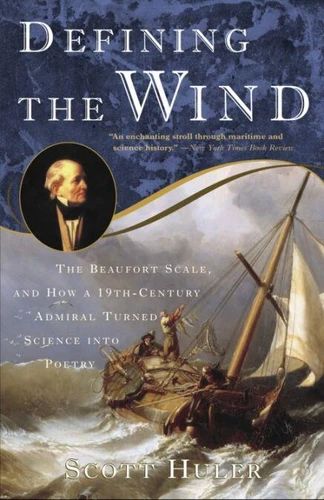
Defining the Wind. The Beaufort Scale and How a 19th-Century Admiral Turned Science into Poetry
Par :Formats :
Disponible dans votre compte client Decitre ou Furet du Nord dès validation de votre commande. Le format ePub protégé est :
- Compatible avec une lecture sur My Vivlio (smartphone, tablette, ordinateur)
- Compatible avec une lecture sur liseuses Vivlio
- Pour les liseuses autres que Vivlio, vous devez utiliser le logiciel Adobe Digital Edition. Non compatible avec la lecture sur les liseuses Kindle, Remarkable et Sony
- Non compatible avec un achat hors France métropolitaine
 , qui est-ce ?
Notre partenaire de plateforme de lecture numérique où vous retrouverez l'ensemble de vos ebooks gratuitement
Pour en savoir plus sur nos ebooks, consultez notre aide en ligne ici
C'est si simple ! Lisez votre ebook avec l'app Vivlio sur votre tablette, mobile ou ordinateur :

- Nombre de pages304
- FormatePub
- ISBN978-0-307-42055-8
- EAN9780307420558
- Date de parution18/12/2007
- Protection num.Adobe DRM
- Taille4 Mo
- Infos supplémentairesepub
- ÉditeurCrown
Résumé
"Nature, rightly questioned, never lies." -A Manual of Scientific Enquiry, Third Edition, 1859Scott Huler was working as a copy editor for a small publisher when he stumbled across the Beaufort Wind Scale in his Merriam Webster Collegiate Dictionary. It was one of those moments of discovery that writers live for. Written centuries ago, its 110 words launched Huler on a remarkable journey over land and sea into a fascinating world of explorers, mariners, scientists, and writers.
After falling in love with what he decided was "the best, clearest, and most vigorous piece of descriptive writing I had ever seen, " Huler went in search of Admiral Francis Beaufort himself: hydrographer to the British Admiralty, man of science, and author-Huler assumed-of the Beaufort Wind Scale. But what Huler discovered is that the scale that carries Beaufort's name has a long and complex evolution, and to properly understand it he had to keep reaching farther back in history, into the lives and works of figures from Daniel Defoe and Charles Darwin to Captains Bligh, of the Bounty, and Cook, of the Endeavor.
As hydrographer to the British Admiralty it was Beaufort's job to track the information that ships relied on: where to lay anchor, descriptions of ports, information about fortification, religion, and trade. But what came to fascinate Huler most about Beaufort was his obsession for observing things and communicating to others what the world looked like. Huler's research landed him in one of the most fascinating and rich periods of history, because all around the world in the mid-eighteenth and nineteenth centuries, in a grand, expansive period, modern science was being invented every day.
These scientific advancements encompassed not only vast leaps in understanding but also how scientific innovation was expressed and even organized, including such enduring developments as the scale Anders Celsius created to simplify how Gabriel Fahrenheit measured temperature; the French-designed metric system; and the Gregorian calendar adopted by France and Great Britain. To Huler, Beaufort came to embody that passion for scientific observation and categorization; indeed Beaufort became the great scientific networker of his time.
It was he, for example, who was tapped to lead the search for a naturalist in the 1830s to accompany the crew of the Beagle; he recommended a young naturalist named Charles Darwin. Defining the Wind is a wonderfully readable, often humorous, and always rich story that is ultimately about how we observe the forces of nature and the world around us.
After falling in love with what he decided was "the best, clearest, and most vigorous piece of descriptive writing I had ever seen, " Huler went in search of Admiral Francis Beaufort himself: hydrographer to the British Admiralty, man of science, and author-Huler assumed-of the Beaufort Wind Scale. But what Huler discovered is that the scale that carries Beaufort's name has a long and complex evolution, and to properly understand it he had to keep reaching farther back in history, into the lives and works of figures from Daniel Defoe and Charles Darwin to Captains Bligh, of the Bounty, and Cook, of the Endeavor.
As hydrographer to the British Admiralty it was Beaufort's job to track the information that ships relied on: where to lay anchor, descriptions of ports, information about fortification, religion, and trade. But what came to fascinate Huler most about Beaufort was his obsession for observing things and communicating to others what the world looked like. Huler's research landed him in one of the most fascinating and rich periods of history, because all around the world in the mid-eighteenth and nineteenth centuries, in a grand, expansive period, modern science was being invented every day.
These scientific advancements encompassed not only vast leaps in understanding but also how scientific innovation was expressed and even organized, including such enduring developments as the scale Anders Celsius created to simplify how Gabriel Fahrenheit measured temperature; the French-designed metric system; and the Gregorian calendar adopted by France and Great Britain. To Huler, Beaufort came to embody that passion for scientific observation and categorization; indeed Beaufort became the great scientific networker of his time.
It was he, for example, who was tapped to lead the search for a naturalist in the 1830s to accompany the crew of the Beagle; he recommended a young naturalist named Charles Darwin. Defining the Wind is a wonderfully readable, often humorous, and always rich story that is ultimately about how we observe the forces of nature and the world around us.