SOLDES
Jusqu'à -70% sur une sélection d'articles*

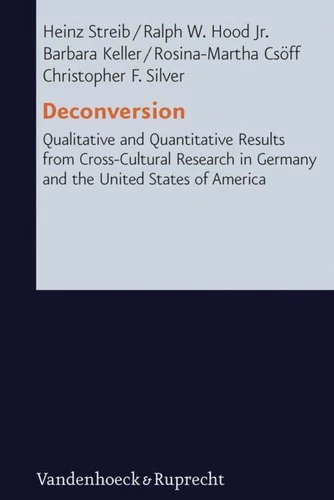
Deconversion. Qualitative and Quantitative Results from Cross-Cultural Research in Germany and the United States of America
Par : , , , ,Formats :
Disponible dans votre compte client Decitre ou Furet du Nord dès validation de votre commande. Le format PDF est :
- Compatible avec une lecture sur My Vivlio (smartphone, tablette, ordinateur)
- Compatible avec une lecture sur liseuses Vivlio
- Pour les liseuses autres que Vivlio, vous devez utiliser le logiciel Adobe Digital Edition. Non compatible avec la lecture sur les liseuses Kindle, Remarkable et Sony
 , qui est-ce ?
Notre partenaire de plateforme de lecture numérique où vous retrouverez l'ensemble de vos ebooks gratuitement
Pour en savoir plus sur nos ebooks, consultez notre aide en ligne ici
C'est si simple ! Lisez votre ebook avec l'app Vivlio sur votre tablette, mobile ou ordinateur :

- Nombre de pages262
- FormatPDF
- ISBN978-3-647-60439-8
- EAN9783647604398
- Date de parution12/07/2011
- Protection num.pas de protection
- Taille10 Mo
- Infos supplémentairespdf
- ÉditeurVandenhoeck & Ruprecht
Résumé
This book presents case studies and empirical data of a phenomenon which increasingly gains popularity in Western societies: deconversion. There is, the authors argue, no better word than deconversion to describe processes of disengagement from religious orientations because these have much in common with conversion. Termination of membership may eventually be the final step of deconversion, but it involves biographical and psychological dynamics which can and need to be reconstructed by qualitative approaches and analyzed by quantitative instruments.
In the Bielefeld-based Cross-Cultural Study on Deconversion disengagement processes from a variety of religious backgrounds in the USA and in Germany were examined, ranging from well-established religious organizations to new religious and fundamentalist groups. Nearly 1, 200 persons participated in thestudy and were interviewed from 2002 to 2005. In the focus of the study are 100 deconverts from the USA and from Germany who were examined with narrative interviews, faith development interviews and an extensive questionnaire.
For case study elaboration, the study followed a research design with an innovative triangulation of qualitative and quantitative data. Four chapters, corresponding to four types of deconversion, present 21 case studies. The highlights of the research project are new data on spirituality - the deconverts in particular appear to prefer a »more spiritual than religious« self-identification - and in-depth analyses of a variety of deconversion narratives with special focus on personality factors, motivation, attitudes, religious development, psychological well-being and growth, religious fundamentalism and right-wing authoritarianism.
The results of this project which was funded by the Deutsche Forschungsgemeinschaft are of special relevance for counselling and pastoral care, for religious education and for people concerned with administration and management of religious groups and churches, but also for a wider audience interested in contemporary changes in the religious fields in the USA and Germany.
In the Bielefeld-based Cross-Cultural Study on Deconversion disengagement processes from a variety of religious backgrounds in the USA and in Germany were examined, ranging from well-established religious organizations to new religious and fundamentalist groups. Nearly 1, 200 persons participated in thestudy and were interviewed from 2002 to 2005. In the focus of the study are 100 deconverts from the USA and from Germany who were examined with narrative interviews, faith development interviews and an extensive questionnaire.
For case study elaboration, the study followed a research design with an innovative triangulation of qualitative and quantitative data. Four chapters, corresponding to four types of deconversion, present 21 case studies. The highlights of the research project are new data on spirituality - the deconverts in particular appear to prefer a »more spiritual than religious« self-identification - and in-depth analyses of a variety of deconversion narratives with special focus on personality factors, motivation, attitudes, religious development, psychological well-being and growth, religious fundamentalism and right-wing authoritarianism.
The results of this project which was funded by the Deutsche Forschungsgemeinschaft are of special relevance for counselling and pastoral care, for religious education and for people concerned with administration and management of religious groups and churches, but also for a wider audience interested in contemporary changes in the religious fields in the USA and Germany.