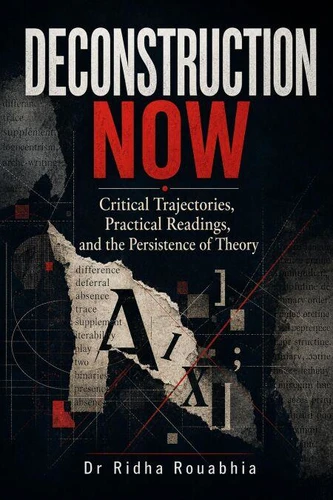
Deconstruction is often declared obsolete, a theory confined to the intellectual battles of the late twentieth century. Yet it persists-reshaped, redistributed, and quietly embedded within contemporary critical practice. Deconstruction Now revisits this paradox, offering a rigorous examination of deconstruction not as a closed chapter, but as a living and contested field. This scholarly monograph traces the evolving trajectories of deconstruction across theoretical debates, methodological challenges, and applied literary analysis.
It explores the tension between expansion and domestication, the question of whether deconstruction can truly be practiced, and its enduring dialogue with other critical frameworks, particularly Marxism and postcolonial theory. Through detailed readings of canonical and modern texts, the book demonstrates how deconstruction continues to unsettle binary oppositions related to race, class, empire, narrative form, and interpretation itself.
Rather than presenting a fixed method, this work approaches deconstruction as a critical practice shaped by context, competence, and intellectual responsibility. It highlights both the possibilities and limitations of deconstructive reading, emphasizing its ethical dimension and its resistance to definitive closure. Bridging theory and practice, Deconstruction Now offers a comprehensive and nuanced account of one of the most influential movements in literary criticism.
It is intended for scholars, researchers, and advanced students who seek to engage seriously with the ongoing relevance of theory in the humanities.
Deconstruction is often declared obsolete, a theory confined to the intellectual battles of the late twentieth century. Yet it persists-reshaped, redistributed, and quietly embedded within contemporary critical practice. Deconstruction Now revisits this paradox, offering a rigorous examination of deconstruction not as a closed chapter, but as a living and contested field. This scholarly monograph traces the evolving trajectories of deconstruction across theoretical debates, methodological challenges, and applied literary analysis.
It explores the tension between expansion and domestication, the question of whether deconstruction can truly be practiced, and its enduring dialogue with other critical frameworks, particularly Marxism and postcolonial theory. Through detailed readings of canonical and modern texts, the book demonstrates how deconstruction continues to unsettle binary oppositions related to race, class, empire, narrative form, and interpretation itself.
Rather than presenting a fixed method, this work approaches deconstruction as a critical practice shaped by context, competence, and intellectual responsibility. It highlights both the possibilities and limitations of deconstructive reading, emphasizing its ethical dimension and its resistance to definitive closure. Bridging theory and practice, Deconstruction Now offers a comprehensive and nuanced account of one of the most influential movements in literary criticism.
It is intended for scholars, researchers, and advanced students who seek to engage seriously with the ongoing relevance of theory in the humanities.

 , qui est-ce ?