OFFRE LISEUSES
Une liseuse achetée = une housse offerte* jusqu'au 21 juin

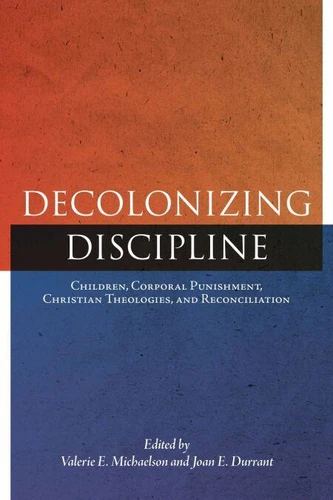
Decolonizing Discipline. Children, Corporal Punishment, Christian Theologies, and Reconciliation
Par : ,Formats :
Disponible dans votre compte client Decitre ou Furet du Nord dès validation de votre commande. Le format ePub est :
- Compatible avec une lecture sur My Vivlio (smartphone, tablette, ordinateur)
- Compatible avec une lecture sur liseuses Vivlio
- Pour les liseuses autres que Vivlio, vous devez utiliser le logiciel Adobe Digital Edition. Non compatible avec la lecture sur les liseuses Kindle, Remarkable et Sony
 , qui est-ce ?
Notre partenaire de plateforme de lecture numérique où vous retrouverez l'ensemble de vos ebooks gratuitement
Pour en savoir plus sur nos ebooks, consultez notre aide en ligne ici
C'est si simple ! Lisez votre ebook avec l'app Vivlio sur votre tablette, mobile ou ordinateur :

- Nombre de pages280
- FormatePub
- ISBN978-0-88755-866-5
- EAN9780887558665
- Date de parution04/09/2020
- Protection num.Digital Watermarking
- Taille594 Ko
- Infos supplémentairesepub
- ÉditeurUniversity of Manitoba Press
Résumé
In June 2015, Canada's Truth and Reconciliation Commission released 94 Calls to Action that urged reform of policies and programs to repair the harms caused by the Indian Residential Schools. Decolonizing Discipline is a response to Call to Action 6--the call to repeal Section 43 of Canada's Criminal Code, which justifies the corporal punishment of children.
Editors Valerie Michaelson and Joan Durrant have brought together diverse voices to respond to this call and to consider the ways that colonial Western interpretations of Christian theologies have been used over centuries to normalize violence and rationalize the physical discipline of children.
Theologians, clergy, social scientists, and First Nations, Inuit, and Métis leaders and community members explore the risks that corporal punishment poses to children and examine practical, non-violent approaches to discipline. The authors invite readers to participate in shaping this country into one that does not sanction violence against children. The result is a multifaceted exploration of theological debates, scientific evidence, and personal journeys of the violence that permeated Canada's Residential Schools and continues in Canadian homes today.
Together, they compel us to decolonize discipline in Canada.
Theologians, clergy, social scientists, and First Nations, Inuit, and Métis leaders and community members explore the risks that corporal punishment poses to children and examine practical, non-violent approaches to discipline. The authors invite readers to participate in shaping this country into one that does not sanction violence against children. The result is a multifaceted exploration of theological debates, scientific evidence, and personal journeys of the violence that permeated Canada's Residential Schools and continues in Canadian homes today.
Together, they compel us to decolonize discipline in Canada.