Nouveauté
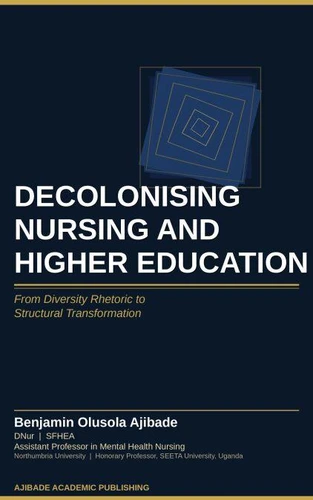
DECOLONISING NURSING AND HIGHER EDUCATION: From Diversity Rhetoric to Structural Transformation
Par :Formats :
Disponible dans votre compte client Decitre ou Furet du Nord dès validation de votre commande. Le format ePub est :
- Compatible avec une lecture sur My Vivlio (smartphone, tablette, ordinateur)
- Compatible avec une lecture sur liseuses Vivlio
- Pour les liseuses autres que Vivlio, vous devez utiliser le logiciel Adobe Digital Edition. Non compatible avec la lecture sur les liseuses Kindle, Remarkable et Sony
 , qui est-ce ?
Notre partenaire de plateforme de lecture numérique où vous retrouverez l'ensemble de vos ebooks gratuitement
Pour en savoir plus sur nos ebooks, consultez notre aide en ligne ici
C'est si simple ! Lisez votre ebook avec l'app Vivlio sur votre tablette, mobile ou ordinateur :

- FormatePub
- ISBN978-1-0667613-7-1
- EAN9781066761371
- Date de parution08/07/2026
- Protection num.pas de protection
- Infos supplémentairesepub
- ÉditeurAjibade Academic Publishing
Résumé
British nursing and higher education have adopted the language of decolonisation while largely preserving the structures, epistemologies, and power relations that make decolonisation necessary. This book is a sustained scholarly argument for why that gap must be closed and how. Moving through four movements, Positioning, Diagnosis, Intervention, and Transformation, Benjamin Olusola Ajibade examines the colonial curriculum and what it refuses to know, the sophisticated mechanisms by which institutions absorb and neutralise decolonisation work, and the ELEVATE institutional programme he founded at Northumbria University as a live case study in building transformative work inside a resistant institution.
The book also addresses what the existing literature has largely avoided: colourism. The differential treatment of Black academics, nurses, and students compared to other racially minoritised colleagues is documented, named, and analysed throughout. The final movement makes systemic demands on the Nursing and Midwifery Council, the Office for Students, NHS England, and institutional leaders, arguing that race conscious practice is not a specialism but a core professional imperative with direct consequences for patient safety, workforce wellbeing, and public health.
Drawing on peer reviewed scholarship in Human Resource Development International, Equity in Education and Society, the British Educational Research Journal, and the British Journal of Mental Health Nursing, this is not a neutral book. It is a manifesto with evidence. For nursing academics, higher education leaders, healthcare educators, policy makers, and practitioners working on equity, decolonisation, and race conscious practice in UK and international contexts.
The book also addresses what the existing literature has largely avoided: colourism. The differential treatment of Black academics, nurses, and students compared to other racially minoritised colleagues is documented, named, and analysed throughout. The final movement makes systemic demands on the Nursing and Midwifery Council, the Office for Students, NHS England, and institutional leaders, arguing that race conscious practice is not a specialism but a core professional imperative with direct consequences for patient safety, workforce wellbeing, and public health.
Drawing on peer reviewed scholarship in Human Resource Development International, Equity in Education and Society, the British Educational Research Journal, and the British Journal of Mental Health Nursing, this is not a neutral book. It is a manifesto with evidence. For nursing academics, higher education leaders, healthcare educators, policy makers, and practitioners working on equity, decolonisation, and race conscious practice in UK and international contexts.