
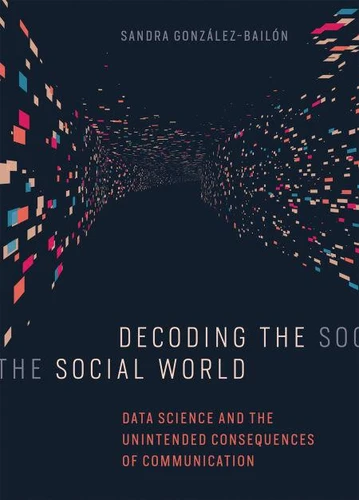
Decoding the Social World. Data Science and the Unintended Consequences of Communication
Par :Formats :
Disponible dans votre compte client Decitre ou Furet du Nord dès validation de votre commande. Le format ePub protégé est :
- Compatible avec une lecture sur My Vivlio (smartphone, tablette, ordinateur)
- Compatible avec une lecture sur liseuses Vivlio
- Pour les liseuses autres que Vivlio, vous devez utiliser le logiciel Adobe Digital Edition. Non compatible avec la lecture sur les liseuses Kindle, Remarkable et Sony
- Non compatible avec un achat hors France métropolitaine
 , qui est-ce ?
Notre partenaire de plateforme de lecture numérique où vous retrouverez l'ensemble de vos ebooks gratuitement
Pour en savoir plus sur nos ebooks, consultez notre aide en ligne ici
C'est si simple ! Lisez votre ebook avec l'app Vivlio sur votre tablette, mobile ou ordinateur :

- Nombre de pages256
- FormatePub
- ISBN978-0-262-34346-6
- EAN9780262343466
- Date de parution22/12/2017
- Protection num.Adobe DRM
- Taille827 Ko
- Infos supplémentairesepub
- ÉditeurThe MIT Press
Résumé
How data science and the analysis of networks help us solve the puzzle of unintended consequences. Social life is full of paradoxes. Our intentional actions often trigger outcomes that we did not intend or even envision. How do we explain those unintended effects and what can we do to regulate them? In Decoding the Social World, Sandra González-Bailón explains how data science and digital traces help us solve the puzzle of unintended consequences-offering the solution to a social paradox that has intrigued thinkers for centuries.
Communication has always been the force that makes a collection of people more than the sum of individuals, but only now can we explain why: digital technologies have made it possible to parse the information we generate by being social in new, imaginative ways. And yet we must look at that data, González-Bailón argues, through the lens of theories that capture the nature of social life. The technologies we use, in the end, are also a manifestation of the social world we inhabit.
González-Bailón discusses how the unpredictability of social life relates to communication networks, social influence, and the unintended effects that derive from individual decisions. She describes how communication generates social dynamics in aggregate (leading to episodes of "collective effervescence") and discusses the mechanisms that underlie large-scale diffusion, when information and behavior spread "like wildfire." She applies the theory of networks to illuminate why collective outcomes can differ drastically even when they arise from the same individual actions.
By opening the black box of unintended effects, González-Bailón identifies strategies for social intervention and discusses the policy implications-and how data science and evidence-based research embolden critical thinking in a world that is constantly changing.
Communication has always been the force that makes a collection of people more than the sum of individuals, but only now can we explain why: digital technologies have made it possible to parse the information we generate by being social in new, imaginative ways. And yet we must look at that data, González-Bailón argues, through the lens of theories that capture the nature of social life. The technologies we use, in the end, are also a manifestation of the social world we inhabit.
González-Bailón discusses how the unpredictability of social life relates to communication networks, social influence, and the unintended effects that derive from individual decisions. She describes how communication generates social dynamics in aggregate (leading to episodes of "collective effervescence") and discusses the mechanisms that underlie large-scale diffusion, when information and behavior spread "like wildfire." She applies the theory of networks to illuminate why collective outcomes can differ drastically even when they arise from the same individual actions.
By opening the black box of unintended effects, González-Bailón identifies strategies for social intervention and discusses the policy implications-and how data science and evidence-based research embolden critical thinking in a world that is constantly changing.