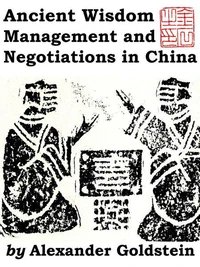
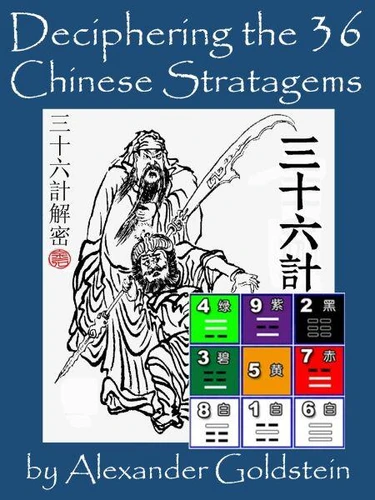
To realise the causes of a great rejuvenation of the Chinese civilization started with the new sixty-year cycle in 1984, we need to have recourse to an inescapable problem of inheritance and further development of cultural traditions in China. In this book the 36 stratagems and their overall characteristics are discussed within the framework of canonical macro and microstructure put through the 'image and numbers' study, the circular and linear arrangements built on the basis of Chinese strategic thinking and stratagemical thoughts.
In the next following Book II entitled "The Strategic Thinking and Stratagemical Thoughts in China, " which is going to be released in a month from now, the subject of our interest is the business negotiation process and the so-called "Chinese-style Management, " as well as the problem of decision-making based on the historical background and systematic guidelines contributed by the sages of old in the form of idiomatically expressed stratagemical thoughts.
In the context of modern globalization, the 36 Chinese stratagems highlight the comparative advantage of Chinese attitude towards management with "ancient wisdom." This book adopts the structural research of "The Thirty-six Stratagems" as a canonical work that has received wide recognition of international experts in the field of strategic psychology and management. Methods adopted in this book include linguistic analysis, inductive and deductive reasoning relied on the canonical patterns; the termed by the book's author the Mortar-Pestle modelling is discussed in detail.
Chinese stratagems represent a collection of some of the most subtle and as it seems to be the most counterintuitive (but it is only on the face of it) precepts on strategic and tactical operations worked out and developed in old China through the past three millenniums. Covering the fields of politics, diplomacy, espionage and business activities, they reflect the human nature in all implicit respects and light up the remotest corners of mind.
There are some striking similarities between "The Thirty-six Stratagems" written by unknown author(s) sometime on the edge of the Ming and Qing dynasties (17th century) and the guiding principles of the "Zhou Yi" (The Book of Circular Changes), as far as both works on strategic thinking strive to derive solutions for difficult problem-solving by maximizing a total benefit and minimizing costs and harmful side effects.
In this edition, the 36 stratagems are described in detail with comparisons of the Zhou Yi's invertible and non-invertible diagrams put into different numeric structures of the circular arrangement. A strategy generation and its successful implementation in advantageous and disadvantageous circumstances are viewed from the standpoint of six warfare categories. Applications of the stratagems in management areas are also discussed through similarities and differences in the strategic psychology in China and in the West.
The book is enriched in dozens of charts and diagrams to invite the reader to master the strategic thinking in traditionally Chinese way to know oneself much better. It is difficult to know oneself if one does not know others; when wanting to know others, first start with yourself. As is said, "if you know the opponent and know yourself, you need not fear the result of a hundred battles." Therefore, the devoted reader will find this fascinating journey in the realm of stratagemical thoughts as a doubly valued in theoretical and practical perspectives.
To realise the causes of a great rejuvenation of the Chinese civilization started with the new sixty-year cycle in 1984, we need to have recourse to an inescapable problem of inheritance and further development of cultural traditions in China. In this book the 36 stratagems and their overall characteristics are discussed within the framework of canonical macro and microstructure put through the 'image and numbers' study, the circular and linear arrangements built on the basis of Chinese strategic thinking and stratagemical thoughts.
In the next following Book II entitled "The Strategic Thinking and Stratagemical Thoughts in China, " which is going to be released in a month from now, the subject of our interest is the business negotiation process and the so-called "Chinese-style Management, " as well as the problem of decision-making based on the historical background and systematic guidelines contributed by the sages of old in the form of idiomatically expressed stratagemical thoughts.
In the context of modern globalization, the 36 Chinese stratagems highlight the comparative advantage of Chinese attitude towards management with "ancient wisdom." This book adopts the structural research of "The Thirty-six Stratagems" as a canonical work that has received wide recognition of international experts in the field of strategic psychology and management. Methods adopted in this book include linguistic analysis, inductive and deductive reasoning relied on the canonical patterns; the termed by the book's author the Mortar-Pestle modelling is discussed in detail.
Chinese stratagems represent a collection of some of the most subtle and as it seems to be the most counterintuitive (but it is only on the face of it) precepts on strategic and tactical operations worked out and developed in old China through the past three millenniums. Covering the fields of politics, diplomacy, espionage and business activities, they reflect the human nature in all implicit respects and light up the remotest corners of mind.
There are some striking similarities between "The Thirty-six Stratagems" written by unknown author(s) sometime on the edge of the Ming and Qing dynasties (17th century) and the guiding principles of the "Zhou Yi" (The Book of Circular Changes), as far as both works on strategic thinking strive to derive solutions for difficult problem-solving by maximizing a total benefit and minimizing costs and harmful side effects.
In this edition, the 36 stratagems are described in detail with comparisons of the Zhou Yi's invertible and non-invertible diagrams put into different numeric structures of the circular arrangement. A strategy generation and its successful implementation in advantageous and disadvantageous circumstances are viewed from the standpoint of six warfare categories. Applications of the stratagems in management areas are also discussed through similarities and differences in the strategic psychology in China and in the West.
The book is enriched in dozens of charts and diagrams to invite the reader to master the strategic thinking in traditionally Chinese way to know oneself much better. It is difficult to know oneself if one does not know others; when wanting to know others, first start with yourself. As is said, "if you know the opponent and know yourself, you need not fear the result of a hundred battles." Therefore, the devoted reader will find this fascinating journey in the realm of stratagemical thoughts as a doubly valued in theoretical and practical perspectives.

 , qui est-ce ?