
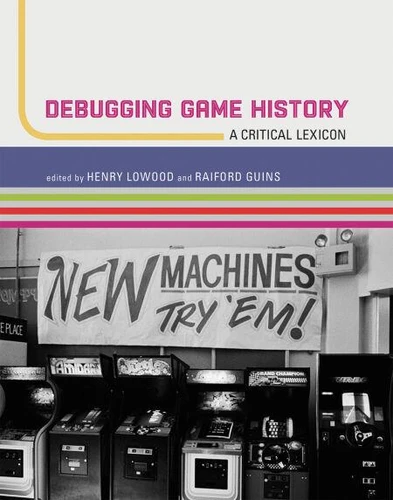
Debugging Game History. A Critical Lexicon
Par : ,Formats :
Disponible dans votre compte client Decitre ou Furet du Nord dès validation de votre commande. Le format ePub protégé est :
- Compatible avec une lecture sur My Vivlio (smartphone, tablette, ordinateur)
- Compatible avec une lecture sur liseuses Vivlio
- Pour les liseuses autres que Vivlio, vous devez utiliser le logiciel Adobe Digital Edition. Non compatible avec la lecture sur les liseuses Kindle, Remarkable et Sony
- Non compatible avec un achat hors France métropolitaine
 , qui est-ce ?
Notre partenaire de plateforme de lecture numérique où vous retrouverez l'ensemble de vos ebooks gratuitement
Pour en savoir plus sur nos ebooks, consultez notre aide en ligne ici
C'est si simple ! Lisez votre ebook avec l'app Vivlio sur votre tablette, mobile ou ordinateur :

- Nombre de pages464
- FormatePub
- ISBN978-0-262-33195-1
- EAN9780262331951
- Date de parution03/06/2016
- Protection num.Adobe DRM
- Taille4 Mo
- Infos supplémentairesepub
- ÉditeurThe MIT Press
Résumé
Essays discuss the terminology, etymology, and history of key terms, offering a foundation for critical historical studies of games. Even as the field of game studies has flourished, critical historical studies of games have lagged behind other areas of research. Histories have generally been fact-by-fact chronicles; fundamental terms of game design and development, technology, and play have rarely been examined in the context of their historical, etymological, and conceptual underpinnings.
This volume attempts to "debug" the flawed historiography of video games. It offers original essays on key concepts in game studies, arranged as in a lexicon-from "Amusement Arcade" to "Embodiment" and "Game Art" to "Simulation" and "World Building." Written by scholars and practitioners from a variety of disciplines, including game development, curatorship, media archaeology, cultural studies, and technology studies, the essays offer a series of distinctive critical "takes" on historical topics.
The majority of essays look at game history from the outside in; some take deep dives into the histories of play and simulation to provide context for the development of electronic and digital games; others take on such technological components of games as code and audio. Not all essays are history or historical etymology-there is an analysis of game design, and a discussion of intellectual property-but they nonetheless raise questions for historians to consider.
Taken together, the essays offer a foundation for the emerging study of game history. ContributorsMarcelo Aranda, Brooke Belisle, Caetlin Benson-Allott, Stephanie Boluk, Jennifer deWinter, J. P. Dyson, Kate Edwards, Mary Flanagan, Jacob Gaboury, William Gibbons, Raiford Guins, Erkki Huhtamo, Don Ihde, Jon Ippolito, Katherine Isbister, Mikael Jakobsson, Steven E. Jones, Jesper Juul, Eric Kaltman, Matthew G.
Kirschenbaum, Carly A. Kocurek, Peter Krapp, Patrick LeMieux, Henry Lowood, Esther MacCallum-Stewart, Ken S. McAllister, Nick Monfort, David Myers, James Newman, Jenna Ng, Michael Nitsche, Laine Nooney, Hector Postigo, Jas Purewal, Reneé H. Reynolds, Judd Ethan Ruggill, Marie-Laure Ryan, Katie Salen Tekinbas, Anastasia Salter, Mark Sample, Bobby Schweizer, John Sharp, Miguel Sicart, Rebecca Elisabeth Skinner, Melanie Swalwell, David Thomas, Samuel Tobin, Emma Witkowski, Mark J.
P. Wolf
This volume attempts to "debug" the flawed historiography of video games. It offers original essays on key concepts in game studies, arranged as in a lexicon-from "Amusement Arcade" to "Embodiment" and "Game Art" to "Simulation" and "World Building." Written by scholars and practitioners from a variety of disciplines, including game development, curatorship, media archaeology, cultural studies, and technology studies, the essays offer a series of distinctive critical "takes" on historical topics.
The majority of essays look at game history from the outside in; some take deep dives into the histories of play and simulation to provide context for the development of electronic and digital games; others take on such technological components of games as code and audio. Not all essays are history or historical etymology-there is an analysis of game design, and a discussion of intellectual property-but they nonetheless raise questions for historians to consider.
Taken together, the essays offer a foundation for the emerging study of game history. ContributorsMarcelo Aranda, Brooke Belisle, Caetlin Benson-Allott, Stephanie Boluk, Jennifer deWinter, J. P. Dyson, Kate Edwards, Mary Flanagan, Jacob Gaboury, William Gibbons, Raiford Guins, Erkki Huhtamo, Don Ihde, Jon Ippolito, Katherine Isbister, Mikael Jakobsson, Steven E. Jones, Jesper Juul, Eric Kaltman, Matthew G.
Kirschenbaum, Carly A. Kocurek, Peter Krapp, Patrick LeMieux, Henry Lowood, Esther MacCallum-Stewart, Ken S. McAllister, Nick Monfort, David Myers, James Newman, Jenna Ng, Michael Nitsche, Laine Nooney, Hector Postigo, Jas Purewal, Reneé H. Reynolds, Judd Ethan Ruggill, Marie-Laure Ryan, Katie Salen Tekinbas, Anastasia Salter, Mark Sample, Bobby Schweizer, John Sharp, Miguel Sicart, Rebecca Elisabeth Skinner, Melanie Swalwell, David Thomas, Samuel Tobin, Emma Witkowski, Mark J.
P. Wolf