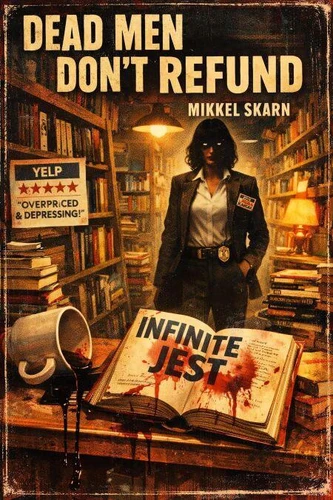
A man who works at a literary bookstore kills a customer named Derek-bludgeoned him with *Infinite Jest* over a refund dispute-and then, in the darkest irony, turned the murder into an ambiguous bestseller called Dead Men Don't Refund. The narrative is unreliable from the start. The protagonist is a bookseller who reads literary fiction obsessively, despises self-help culture, treats Derek's desperate pleas for meaning with contempt, and in one moment of rage, ends his life.
Then spends years building a narrative around the crime-publishing it as fiction, accepting acclaim, watching it become a bestseller based on its ambiguity about whether the murder really happened. But Derek's sister Caroline sees through it. She has the receipts, the evidence, the knowledge of what actually occurred. She writes her own account. The truth. And the literary world turns. The protagonist's book is pulled from shelves, his agent drops him, his publisher abandons him, Netflix kills the adaptation.
He becomes the thing he despised most: a pariah, a fraud, a murderer who profited from his crime and then lost everything when he was exposed. Years later, he's working at a different bookstore, going by a different name-Mark-shelving airport thrillers and corporate biographies. Anonymous. Erased. A different kind of death. Then a customer comes in holding a copy of Dead Men Don't Refund and demands a refund.
Dead Men Don't Refund is a psychological noir about guilt that never diminishes, remorse that arrives too late, the performance of literary sophistication masking cruelty, and what happens when the consequence finally catches up. It's about the profound moral failure of treating another human's suffering as material for your art. It's about the kind of murder that doesn't end with a body-it ends with the slow recognition that you can't hide, that you can't write your way out, that the only escape is invisibility and the faint, unbearable hope that the people you destroyed might, somehow, move on without you.
The narrator hallucinates Derek throughout the novel. Or does he? The unreliability is the point. Nothing is trustworthy in the account of a man who killed over a book dispute and then monetized the killing. By the end, the reader no longer knows what's real-only that guilt doesn't diminish, that some crimes can't be written away, and that the worst punishment isn't death. It's living with the knowledge of what you've done.
A man who works at a literary bookstore kills a customer named Derek-bludgeoned him with *Infinite Jest* over a refund dispute-and then, in the darkest irony, turned the murder into an ambiguous bestseller called Dead Men Don't Refund. The narrative is unreliable from the start. The protagonist is a bookseller who reads literary fiction obsessively, despises self-help culture, treats Derek's desperate pleas for meaning with contempt, and in one moment of rage, ends his life.
Then spends years building a narrative around the crime-publishing it as fiction, accepting acclaim, watching it become a bestseller based on its ambiguity about whether the murder really happened. But Derek's sister Caroline sees through it. She has the receipts, the evidence, the knowledge of what actually occurred. She writes her own account. The truth. And the literary world turns. The protagonist's book is pulled from shelves, his agent drops him, his publisher abandons him, Netflix kills the adaptation.
He becomes the thing he despised most: a pariah, a fraud, a murderer who profited from his crime and then lost everything when he was exposed. Years later, he's working at a different bookstore, going by a different name-Mark-shelving airport thrillers and corporate biographies. Anonymous. Erased. A different kind of death. Then a customer comes in holding a copy of Dead Men Don't Refund and demands a refund.
Dead Men Don't Refund is a psychological noir about guilt that never diminishes, remorse that arrives too late, the performance of literary sophistication masking cruelty, and what happens when the consequence finally catches up. It's about the profound moral failure of treating another human's suffering as material for your art. It's about the kind of murder that doesn't end with a body-it ends with the slow recognition that you can't hide, that you can't write your way out, that the only escape is invisibility and the faint, unbearable hope that the people you destroyed might, somehow, move on without you.
The narrator hallucinates Derek throughout the novel. Or does he? The unreliability is the point. Nothing is trustworthy in the account of a man who killed over a book dispute and then monetized the killing. By the end, the reader no longer knows what's real-only that guilt doesn't diminish, that some crimes can't be written away, and that the worst punishment isn't death. It's living with the knowledge of what you've done.


 , qui est-ce ?
