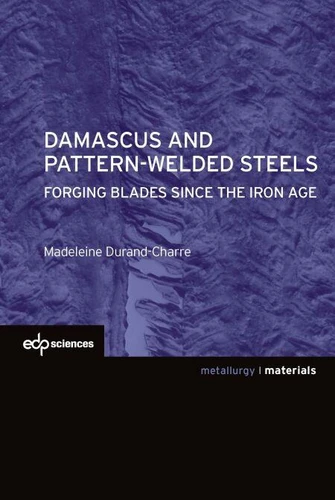
Steels are a class of materials with multiple and complicated transformations; this is true even for steels of the basic cutlery industry. A damascus steel is a fascinating subject to study, rich in multiple facets, that appears in a ?rst approach as a composite material artistically exploited.
Damacus steel was developed in the ?rst millennium AD in India or Sri-Lanka. Its reputation is related to its exceptional properties and to the moire pattern.
A similar damask pattern could be obtained by forge-welding giving rise to controversies. Recent ?ndings allow a better understanding of this pattern formation.
This book presents ?rstly, observations of ancient blade samples examined with modern technologies such as electron microscopy. The features of many typical swords from different periods are discussed: Celtic, Merovingian, Viking and oriental wootz swords, Persian shamshirs, Japanese katana, rapiers etc.
In the second part, microstructural observations at different levels of magni?cation are displayed and their interpretation is discussed in detail, thus revealing the secret of sophisticated forgings. One chapter is devoted to introducing the main transformations undergone by these steels during the forging processes.
The book is intended for all those people interested in the history of science and more speci?cally to the metallurgists, to the archaeologists and all the researchers confronted with the problems of the expertise of the vestiges, to the blacksmiths, and to the collectors of valuable artistic blades.
Madeleine Durand-Charre has taught structural metallurgy at the Polytechnic Institute of Grenoble and at the University Joseph Fourier of Grenoble.
Her research work concerned microstructure formation and determination of phase equilibria. She investigated complex alloys such as superalloys and steels. Her work on vanadium cast irons was awarded the Vanadium Shield in 1989 from the Institute of Metals. She is author of several books and articles in metallurgy.
Steels are a class of materials with multiple and complicated transformations; this is true even for steels of the basic cutlery industry. A damascus steel is a fascinating subject to study, rich in multiple facets, that appears in a ?rst approach as a composite material artistically exploited.
Damacus steel was developed in the ?rst millennium AD in India or Sri-Lanka. Its reputation is related to its exceptional properties and to the moire pattern.
A similar damask pattern could be obtained by forge-welding giving rise to controversies. Recent ?ndings allow a better understanding of this pattern formation.
This book presents ?rstly, observations of ancient blade samples examined with modern technologies such as electron microscopy. The features of many typical swords from different periods are discussed: Celtic, Merovingian, Viking and oriental wootz swords, Persian shamshirs, Japanese katana, rapiers etc.
In the second part, microstructural observations at different levels of magni?cation are displayed and their interpretation is discussed in detail, thus revealing the secret of sophisticated forgings. One chapter is devoted to introducing the main transformations undergone by these steels during the forging processes.
The book is intended for all those people interested in the history of science and more speci?cally to the metallurgists, to the archaeologists and all the researchers confronted with the problems of the expertise of the vestiges, to the blacksmiths, and to the collectors of valuable artistic blades.
Madeleine Durand-Charre has taught structural metallurgy at the Polytechnic Institute of Grenoble and at the University Joseph Fourier of Grenoble.
Her research work concerned microstructure formation and determination of phase equilibria. She investigated complex alloys such as superalloys and steels. Her work on vanadium cast irons was awarded the Vanadium Shield in 1989 from the Institute of Metals. She is author of several books and articles in metallurgy.