Cybernetic Revolutionaries. Technology and Politics in Allende's Chile
Par :Formats :
Disponible dans votre compte client Decitre ou Furet du Nord dès validation de votre commande. Le format ePub protégé est :
- Compatible avec une lecture sur My Vivlio (smartphone, tablette, ordinateur)
- Compatible avec une lecture sur liseuses Vivlio
- Pour les liseuses autres que Vivlio, vous devez utiliser le logiciel Adobe Digital Edition. Non compatible avec la lecture sur les liseuses Kindle, Remarkable et Sony
- Non compatible avec un achat hors France métropolitaine
 , qui est-ce ?
Notre partenaire de plateforme de lecture numérique où vous retrouverez l'ensemble de vos ebooks gratuitement
Pour en savoir plus sur nos ebooks, consultez notre aide en ligne ici
C'est si simple ! Lisez votre ebook avec l'app Vivlio sur votre tablette, mobile ou ordinateur :

- Nombre de pages342
- FormatePub
- ISBN978-0-262-29738-7
- EAN9780262297387
- Date de parution28/10/2011
- Protection num.Adobe DRM
- Taille9 Mo
- Infos supplémentairesepub
- ÉditeurThe MIT Press
Résumé
A historical study of Chile's twin experiments with cybernetics and socialism, and what they tell us about the relationship of technology and politics. In Cybernetic Revolutionaries, Eden Medina tells the history of two intersecting utopian visions, one political and one technological. The first was Chile's experiment with peaceful socialist change under Salvador Allende; the second was the simultaneous attempt to build a computer system that would manage Chile's economy.
Neither vision was fully realized-Allende's government ended with a violent military coup; the system, known as Project Cybersyn, was never completely implemented-but they hold lessons for today about the relationship between technology and politics. Drawing on extensive archival material and interviews, Medina examines the cybernetic system envisioned by the Chilean government-which was to feature holistic system design, decentralized management, human-computer interaction, a national telex network, near real-time control of the growing industrial sector, and modeling the behavior of dynamic systems.
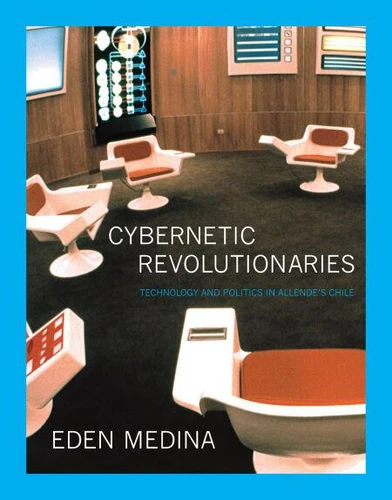
She also describes, and documents with photographs, the network's Star Trek-like operations room, which featured swivel chairs with armrest control panels, a wall of screens displaying data, and flashing red lights to indicate economic emergencies. Studying project Cybersyn today helps us understand not only the technological ambitions of a government in the midst of political change but also the limitations of the Chilean revolution.
This history further shows how human attempts to combine the political and the technological with the goal of creating a more just society can open new technological, intellectual, and political possibilities. Technologies, Medina writes, are historical texts; when we read them we are reading history.
Neither vision was fully realized-Allende's government ended with a violent military coup; the system, known as Project Cybersyn, was never completely implemented-but they hold lessons for today about the relationship between technology and politics. Drawing on extensive archival material and interviews, Medina examines the cybernetic system envisioned by the Chilean government-which was to feature holistic system design, decentralized management, human-computer interaction, a national telex network, near real-time control of the growing industrial sector, and modeling the behavior of dynamic systems.
She also describes, and documents with photographs, the network's Star Trek-like operations room, which featured swivel chairs with armrest control panels, a wall of screens displaying data, and flashing red lights to indicate economic emergencies. Studying project Cybersyn today helps us understand not only the technological ambitions of a government in the midst of political change but also the limitations of the Chilean revolution.
This history further shows how human attempts to combine the political and the technological with the goal of creating a more just society can open new technological, intellectual, and political possibilities. Technologies, Medina writes, are historical texts; when we read them we are reading history.