
Zinon Papakonstantinou is Professor of Classics at the University of Illinois at Chicago. A cultural historian of ancient Greece, his research interests span the entire Greco-Roman antiquity (8th century BCE - 4th century CE) as well as the field of Classical reception, with a particular emphasis on sport, magic, popular culture, disputes and legalities.
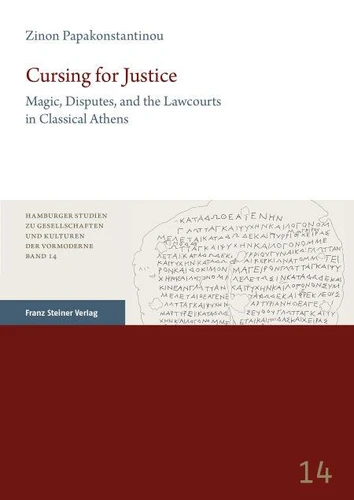
Cursing for Justice. Magic, Disputes, and the Lawcourts in Classical Athens
Par :Formats :
Disponible dans votre compte client Decitre ou Furet du Nord dès validation de votre commande. Le format PDF est :
- Compatible avec une lecture sur My Vivlio (smartphone, tablette, ordinateur)
- Compatible avec une lecture sur liseuses Vivlio
- Pour les liseuses autres que Vivlio, vous devez utiliser le logiciel Adobe Digital Edition. Non compatible avec la lecture sur les liseuses Kindle, Remarkable et Sony
 , qui est-ce ?
Notre partenaire de plateforme de lecture numérique où vous retrouverez l'ensemble de vos ebooks gratuitement
Pour en savoir plus sur nos ebooks, consultez notre aide en ligne ici
C'est si simple ! Lisez votre ebook avec l'app Vivlio sur votre tablette, mobile ou ordinateur :

- Nombre de pages167
- FormatPDF
- ISBN978-3-515-12919-0
- EAN9783515129190
- Date de parution04/03/2021
- Protection num.Digital Watermarking
- Taille1 Mo
- Infos supplémentairespdf
- ÉditeurFranz Steiner
Résumé
This e-book is a comprehensive exploration of curse tablets in the Athenian legal domain. Drawing on sociological and critical theory, Zinon Papakonstantinou outlines a framework for the interaction between curse tablets and legalities, namely in both formal and informal manifestations of the legal sphere, in Classical Athens. By delving into the complex world of Athenian daily life and disputes, Papakonstantinou argues that Athenians involved in litigation deployed binding curses as polysemic acts of conflict management and information control.
They also used them as transgressive transcripts that went beyond normative or legislative taxonomies. Further, Papakonstantinou demonstrates how Athenians acting in a self-assessing and long-term agential mode employed curse tablets strategically to advance their individual agenda and position in Athenian society. As a result, Athenian legal curse tablets point to a conceptually malleable perception of "law" and "litigation" driven by utility and self-interest that clashed with claims to justice, the pursuit of the rule of law, and attitudes towards jurors articulated by litigants in Athenian forensic orations.
They also used them as transgressive transcripts that went beyond normative or legislative taxonomies. Further, Papakonstantinou demonstrates how Athenians acting in a self-assessing and long-term agential mode employed curse tablets strategically to advance their individual agenda and position in Athenian society. As a result, Athenian legal curse tablets point to a conceptually malleable perception of "law" and "litigation" driven by utility and self-interest that clashed with claims to justice, the pursuit of the rule of law, and attitudes towards jurors articulated by litigants in Athenian forensic orations.