
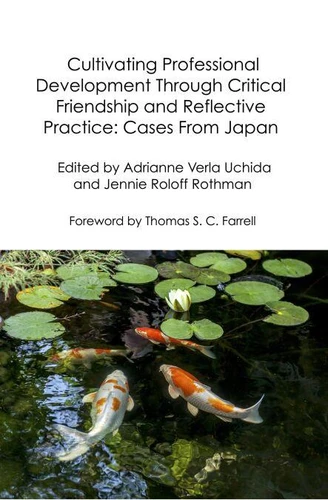
Cultivating Professional Development Through Critical Friendship and Reflective Practice: Cases From Japan
Par : ,Formats :
Disponible dans votre compte client Decitre ou Furet du Nord dès validation de votre commande. Le format ePub est :
- Compatible avec une lecture sur My Vivlio (smartphone, tablette, ordinateur)
- Compatible avec une lecture sur liseuses Vivlio
- Pour les liseuses autres que Vivlio, vous devez utiliser le logiciel Adobe Digital Edition. Non compatible avec la lecture sur les liseuses Kindle, Remarkable et Sony
 , qui est-ce ?
Notre partenaire de plateforme de lecture numérique où vous retrouverez l'ensemble de vos ebooks gratuitement
Pour en savoir plus sur nos ebooks, consultez notre aide en ligne ici
C'est si simple ! Lisez votre ebook avec l'app Vivlio sur votre tablette, mobile ou ordinateur :

- FormatePub
- ISBN8215898604
- EAN9798215898604
- Date de parution13/10/2023
- Protection num.pas de protection
- Infos supplémentairesepub
- ÉditeurWMG Publishing
Résumé
Cultivating Professional Development through Critical Friendship and Reflective Practice: Cases from Japan, edited by Adrianne Verla Uchida and Jennie Roloff Rothman, shows us an innovative bottom-up approach to professional development for educators. A critical friendship is where "two teachers come together willingly to explore facets of their development as decided by the friends" (Farrell, Foreword).
These individuals might be colleagues, close friends or acquaintances who are an "invaluable, integral aspect of your personal growth as a professional" (Verla Uchida & Roloff-Rothman, Introduction). This volume enhances our knowledge of reflective practice and makes a valuable contribution to the field. The editors and contributing authors show how reflective practice can foster critical friendships as a means of professional development for educators.
The book consists of 11 chapters, organized into three parts, based on the type of critical friendship: intra-institutional friendships (those at the same institution), inter-institutional friendships (cross-institutional friendships), and those extra-institutional friendships (friendships that evolved beyond institutions). The editors draw on Farrell's (2019) six reflective principles to examine how the critical friendship framework possesses a flexibility that fosters meaningful and supportive professional relationships.
Although the chapters detail critical friendships in Japan, the themes are equally relevant for educators elsewhere. The context-specific and detailed documentation of the contributors' stories makes the volume a valuable and inspiring resource for any educator. The volume will undoubtably prompt readers to nurture and reflect on their own critical friendships.
These individuals might be colleagues, close friends or acquaintances who are an "invaluable, integral aspect of your personal growth as a professional" (Verla Uchida & Roloff-Rothman, Introduction). This volume enhances our knowledge of reflective practice and makes a valuable contribution to the field. The editors and contributing authors show how reflective practice can foster critical friendships as a means of professional development for educators.
The book consists of 11 chapters, organized into three parts, based on the type of critical friendship: intra-institutional friendships (those at the same institution), inter-institutional friendships (cross-institutional friendships), and those extra-institutional friendships (friendships that evolved beyond institutions). The editors draw on Farrell's (2019) six reflective principles to examine how the critical friendship framework possesses a flexibility that fosters meaningful and supportive professional relationships.
Although the chapters detail critical friendships in Japan, the themes are equally relevant for educators elsewhere. The context-specific and detailed documentation of the contributors' stories makes the volume a valuable and inspiring resource for any educator. The volume will undoubtably prompt readers to nurture and reflect on their own critical friendships.