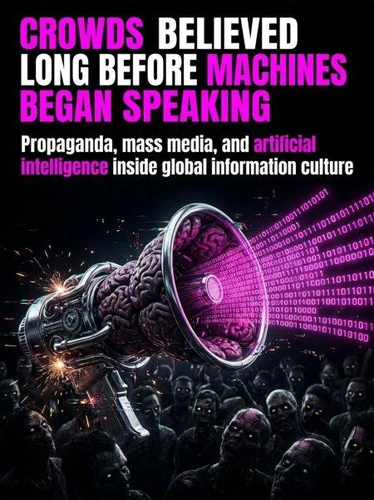
Crowds Believed Long Before Machines Began Speaking. Propaganda, mass media, and artificial intelligence inside global information culture
Par :Formats :
Disponible dans votre compte client Decitre ou Furet du Nord dès validation de votre commande. Le format ePub est :
- Compatible avec une lecture sur My Vivlio (smartphone, tablette, ordinateur)
- Compatible avec une lecture sur liseuses Vivlio
- Pour les liseuses autres que Vivlio, vous devez utiliser le logiciel Adobe Digital Edition. Non compatible avec la lecture sur les liseuses Kindle, Remarkable et Sony
 , qui est-ce ?
Notre partenaire de plateforme de lecture numérique où vous retrouverez l'ensemble de vos ebooks gratuitement
Pour en savoir plus sur nos ebooks, consultez notre aide en ligne ici
C'est si simple ! Lisez votre ebook avec l'app Vivlio sur votre tablette, mobile ou ordinateur :

- Nombre de pages150
- FormatePub
- ISBN978-3-565-48631-1
- EAN9783565486311
- Date de parution08/06/2026
- Protection num.pas de protection
- Taille952 Ko
- Infos supplémentairesepub
- ÉditeurEmphaloz Publishing House
Résumé
Human networks rarely reward truth alone. Throughout history, societies have preserved stability by circulating stories capable of binding strangers together, even when those stories distorted reality. Information systems therefore evolved not merely to inform populations, but to coordinate belief itself.
This account examines how propaganda and collective narratives shaped political order from the ancient world to the digital age.
Religious texts, state bureaucracies, newspapers, and broadcast media all strengthened large-scale cooperation by filtering which versions of reality became socially acceptable. The modern global network intensified this process, allowing misinformation, emotional signaling, and ideological repetition to spread faster than factual correction. The book then turns to artificial intelligence as a new historical actor.
Unlike earlier technologies that transmitted human decisions, AI systems increasingly generate recommendations, narratives, and persuasive structures autonomously. This creates unprecedented risks for democratic institutions, social trust, and human agency itself. The danger lies not only in false information, but in systems capable of adapting persuasion strategically without human intention guiding every step. Seen historically, the digital era represents less a communication revolution than a transformation in who - or what - participates in shaping collective belief.
Religious texts, state bureaucracies, newspapers, and broadcast media all strengthened large-scale cooperation by filtering which versions of reality became socially acceptable. The modern global network intensified this process, allowing misinformation, emotional signaling, and ideological repetition to spread faster than factual correction. The book then turns to artificial intelligence as a new historical actor.
Unlike earlier technologies that transmitted human decisions, AI systems increasingly generate recommendations, narratives, and persuasive structures autonomously. This creates unprecedented risks for democratic institutions, social trust, and human agency itself. The danger lies not only in false information, but in systems capable of adapting persuasion strategically without human intention guiding every step. Seen historically, the digital era represents less a communication revolution than a transformation in who - or what - participates in shaping collective belief.
A propos de Emma Whitaker


24,99 €

24,99 €