SOLDES
Jusqu'à -70% sur une sélection d'articles*
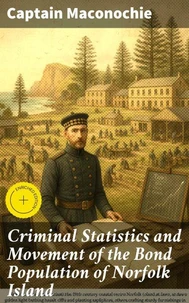
Criminal Statistics and Movement of the Bond Population of Norfolk Island
Par :Formats :
Disponible dans votre compte client Decitre ou Furet du Nord dès validation de votre commande. Le format ePub est :
- Compatible avec une lecture sur My Vivlio (smartphone, tablette, ordinateur)
- Compatible avec une lecture sur liseuses Vivlio
- Pour les liseuses autres que Vivlio, vous devez utiliser le logiciel Adobe Digital Edition. Non compatible avec la lecture sur les liseuses Kindle, Remarkable et Sony
 , qui est-ce ?
Notre partenaire de plateforme de lecture numérique où vous retrouverez l'ensemble de vos ebooks gratuitement
Pour en savoir plus sur nos ebooks, consultez notre aide en ligne ici
C'est si simple ! Lisez votre ebook avec l'app Vivlio sur votre tablette, mobile ou ordinateur :

- Nombre de pages56
- FormatePub
- ISBN859-65--4732165-1
- EAN8596547321651
- Date de parution15/09/2022
- Protection num.Digital Watermarking
- Taille6 Mo
- Infos supplémentairesepub
- ÉditeurDIGICAT
Résumé
In "Criminal Statistics and Movement of the Bond Population of Norfolk Island, " Captain Maconochie meticulously compiles and analyzes the sociological dynamics of penal colonies during the 19th century. His scholarly work employs a blend of statistical analysis and narrative prose to illuminate the conditions and movements of convicts, or the 'bond population, ' revealing a complex picture of penal administration.
Maconochie's examination critiques contemporary punitive measures while contextualizing them within the broader framework of colonial governance and social reform, showcasing his nuanced understanding of penal theory and its application in a harsh landscape. Captain Maconochie, a Scottish naval officer and a notable reformer, was deeply influenced by the evolving discourse surrounding criminal justice and rehabilitation during his era.
His experiences overseeing Norfolk Island-a notorious penal colony-provided him with firsthand insight into the failed systems of punishment, which ultimately inspired him to advocate for meaningful reform. He believed in the potential for redemption in every individual, challenging the prevailing perceptions of criminality and punishment that characterized his time. This text is essential reading for scholars of criminology, colonial studies, and social reform.
Maconochie's rigorous approach and humanistic perspective offer valuable lessons on the implications of penal policy-a theme that remains resonant today. Readers interested in the historical intersection of law, morality, and societal responsibility will find Maconochie's analysis not only enlightening but also a call for empathy and reform that is as relevant now as it was then.
Maconochie's examination critiques contemporary punitive measures while contextualizing them within the broader framework of colonial governance and social reform, showcasing his nuanced understanding of penal theory and its application in a harsh landscape. Captain Maconochie, a Scottish naval officer and a notable reformer, was deeply influenced by the evolving discourse surrounding criminal justice and rehabilitation during his era.
His experiences overseeing Norfolk Island-a notorious penal colony-provided him with firsthand insight into the failed systems of punishment, which ultimately inspired him to advocate for meaningful reform. He believed in the potential for redemption in every individual, challenging the prevailing perceptions of criminality and punishment that characterized his time. This text is essential reading for scholars of criminology, colonial studies, and social reform.
Maconochie's rigorous approach and humanistic perspective offer valuable lessons on the implications of penal policy-a theme that remains resonant today. Readers interested in the historical intersection of law, morality, and societal responsibility will find Maconochie's analysis not only enlightening but also a call for empathy and reform that is as relevant now as it was then.