SOLDES
Jusqu'à -70% sur une sélection d'articles*

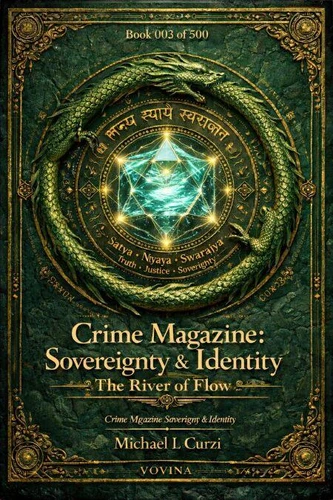
Crime Magazine: Sovereignty & Identity: The River of Flow. VOVINA, #3
Par :Formats :
Disponible dans votre compte client Decitre ou Furet du Nord dès validation de votre commande. Le format ePub est :
- Compatible avec une lecture sur My Vivlio (smartphone, tablette, ordinateur)
- Compatible avec une lecture sur liseuses Vivlio
- Pour les liseuses autres que Vivlio, vous devez utiliser le logiciel Adobe Digital Edition. Non compatible avec la lecture sur les liseuses Kindle, Remarkable et Sony
 , qui est-ce ?
Notre partenaire de plateforme de lecture numérique où vous retrouverez l'ensemble de vos ebooks gratuitement
Pour en savoir plus sur nos ebooks, consultez notre aide en ligne ici
C'est si simple ! Lisez votre ebook avec l'app Vivlio sur votre tablette, mobile ou ordinateur :

- Date de parution31/10/2026
- FormatePub
- ISBN8903905027
- EAN9798903905027
- Protection num.pas de protection
- Infos supplémentairesepub
- Éditeur36N9 GENETICS
Résumé
Crime Magazine: Sovereignty & Identity - The River of Flow is the third volume in Michael L. Curzi's ambitious Vovina Ontological OmniTautology, a 500-book philosophical and investigative canon exploring the architecture of consciousness, governance, and civilization. Following The Origin Principle and The Structure of Order, this volume investigates the dynamic principle that links sovereignty and structure: flow-the living movement through which systems maintain coherence, adapt, and evolve.
If the first volume asks where sovereignty originates and the second explores how order forms from that sovereignty, The River of Flow examines the deeper question: how living systems sustain themselves through circulation, exchange, and transformation. Drawing on philosophy, systems science, law, economics, and historical precedent, Curzi argues that the health of any civilization depends on its ability to maintain balanced flows of value-material, social, intellectual, and ecological.
The book unfolds through nineteen architecturally structured chapters organized around a Fibonacci framework that mirrors the broader design of the Vovina canon. Each chapter follows a layered inquiry process-observation, discrimination, application, connection, and integration-guiding the reader from conceptual understanding toward participatory insight. The work is therefore not simply descriptive; it functions as a method for perceiving and interacting with complex systems.
At the center of the volume is the Sanskrit root SHAKTI, interpreted as the mechanics of power and the dynamics through which authority actually operates in practice. Rather than treating power as a static possession of institutions or individuals, Curzi frames it as a field phenomenon, emerging through patterns of relationship and participation. In this framework, sovereignty, governance, and economic exchange become expressions of a deeper energetic architecture that links consciousness, law, and material systems.
Several major structural ideas are developed throughout the book. One is the concept of a Triple Ledger, which records every transaction across three simultaneous domains: economic value, social impact, and ecological consequence. According to Curzi, traditional single-ledger accounting produces systemic blindness by ignoring the social and environmental costs that inevitably accompany financial activity.
The Triple Ledger seeks to correct this imbalance by embedding multidimensional accountability directly into economic systems. Complementing this model is the framework of Nine Forms of Capital-financial, manufactured, natural, social, human, intellectual, cultural, experiential, and systemic-demonstrating that monetary wealth represents only one dimension of value within a broader ecosystem of resources and relationships.
The health of societies, Curzi argues, depends on maintaining equilibrium across all nine forms rather than maximizing any single metric. The volume also explores unconventional legal and political structures emerging in a networked world. Among these is the concept of non-territorial sovereignty, which challenges the traditional Westphalian model of state authority tied to physical land. Instead, Curzi proposes forms of jurisdiction rooted in stewardship over "interstitial domains"-the spaces between conventional borders, including cyberspace, international commons, and the inner domain of conscience itself.
If the first volume asks where sovereignty originates and the second explores how order forms from that sovereignty, The River of Flow examines the deeper question: how living systems sustain themselves through circulation, exchange, and transformation. Drawing on philosophy, systems science, law, economics, and historical precedent, Curzi argues that the health of any civilization depends on its ability to maintain balanced flows of value-material, social, intellectual, and ecological.
The book unfolds through nineteen architecturally structured chapters organized around a Fibonacci framework that mirrors the broader design of the Vovina canon. Each chapter follows a layered inquiry process-observation, discrimination, application, connection, and integration-guiding the reader from conceptual understanding toward participatory insight. The work is therefore not simply descriptive; it functions as a method for perceiving and interacting with complex systems.
At the center of the volume is the Sanskrit root SHAKTI, interpreted as the mechanics of power and the dynamics through which authority actually operates in practice. Rather than treating power as a static possession of institutions or individuals, Curzi frames it as a field phenomenon, emerging through patterns of relationship and participation. In this framework, sovereignty, governance, and economic exchange become expressions of a deeper energetic architecture that links consciousness, law, and material systems.
Several major structural ideas are developed throughout the book. One is the concept of a Triple Ledger, which records every transaction across three simultaneous domains: economic value, social impact, and ecological consequence. According to Curzi, traditional single-ledger accounting produces systemic blindness by ignoring the social and environmental costs that inevitably accompany financial activity.
The Triple Ledger seeks to correct this imbalance by embedding multidimensional accountability directly into economic systems. Complementing this model is the framework of Nine Forms of Capital-financial, manufactured, natural, social, human, intellectual, cultural, experiential, and systemic-demonstrating that monetary wealth represents only one dimension of value within a broader ecosystem of resources and relationships.
The health of societies, Curzi argues, depends on maintaining equilibrium across all nine forms rather than maximizing any single metric. The volume also explores unconventional legal and political structures emerging in a networked world. Among these is the concept of non-territorial sovereignty, which challenges the traditional Westphalian model of state authority tied to physical land. Instead, Curzi proposes forms of jurisdiction rooted in stewardship over "interstitial domains"-the spaces between conventional borders, including cyberspace, international commons, and the inner domain of conscience itself.