
Dr. Federica Iurescia ist wissenschaftliche Mitarbeiterin am Seminar für Lateinische und Griechische Philologie der Universität Zürich.
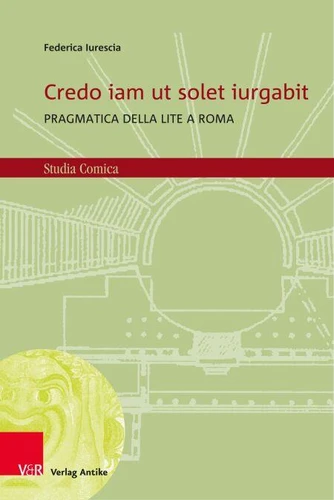
Credo iam ut solet iurgabit. Pragmatica della lite a Roma
Par :Formats :
Disponible dans votre compte client Decitre ou Furet du Nord dès validation de votre commande. Le format PDF est :
- Compatible avec une lecture sur My Vivlio (smartphone, tablette, ordinateur)
- Compatible avec une lecture sur liseuses Vivlio
- Pour les liseuses autres que Vivlio, vous devez utiliser le logiciel Adobe Digital Edition. Non compatible avec la lecture sur les liseuses Kindle, Remarkable et Sony
 , qui est-ce ?
Notre partenaire de plateforme de lecture numérique où vous retrouverez l'ensemble de vos ebooks gratuitement
Pour en savoir plus sur nos ebooks, consultez notre aide en ligne ici
C'est si simple ! Lisez votre ebook avec l'app Vivlio sur votre tablette, mobile ou ordinateur :

- Nombre de pages267
- FormatPDF
- ISBN978-3-946317-39-5
- EAN9783946317395
- Date de parution15/04/2019
- Protection num.pas de protection
- Taille4 Mo
- Infos supplémentairespdf
- ÉditeurVandenhoeck & Ruprecht
Résumé
The research is concerned with verbal and non-verbal behaviour during private quarrels in ancient Rome.
Its aim is twofold: as first, to offer a linguistic description of the expressions occurring in this kind of conflictual communication; as second, to attempt a reconstruction of the behavioural code underpinning it.
The theoretical approach that Federica Iurescia applies to the Latin literary texts is to be framed in the realm of impoliteness theories: they provide methodological tools which proved to be the most suitable for a thorough pragmatic description of the speakers' behaviour.
After the introduction where the state of the research and the authors stance in this realm of studies are described, she focuses on representations of quarrels, in order to show the language use; starting from the metalanguage about quarrel's lexicon, she presents the results of a lexical enquiry on the main Latin terms for quarrel, in order to gain further information about the speakers' perceptions of this interaction.
Both these proceedings point to the same evidence: Latin texts tend to show a negative evaluation of quarrelling.
After the introduction where the state of the research and the authors stance in this realm of studies are described, she focuses on representations of quarrels, in order to show the language use; starting from the metalanguage about quarrel's lexicon, she presents the results of a lexical enquiry on the main Latin terms for quarrel, in order to gain further information about the speakers' perceptions of this interaction.
Both these proceedings point to the same evidence: Latin texts tend to show a negative evaluation of quarrelling.