
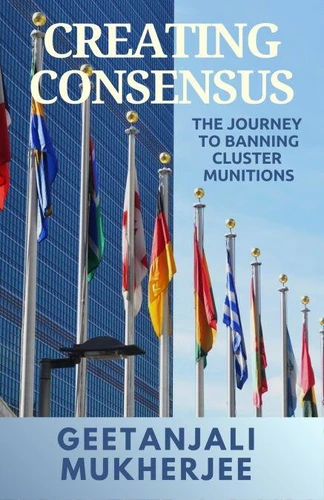
Creating Consensus: The Journey Towards Banning Cluster Munitions
Par :Formats :
Disponible dans votre compte client Decitre ou Furet du Nord dès validation de votre commande. Le format ePub protégé est :
- Compatible avec une lecture sur My Vivlio (smartphone, tablette, ordinateur)
- Compatible avec une lecture sur liseuses Vivlio
- Pour les liseuses autres que Vivlio, vous devez utiliser le logiciel Adobe Digital Edition. Non compatible avec la lecture sur les liseuses Kindle, Remarkable et Sony
- Non compatible avec un achat hors France métropolitaine
 , qui est-ce ?
Notre partenaire de plateforme de lecture numérique où vous retrouverez l'ensemble de vos ebooks gratuitement
Pour en savoir plus sur nos ebooks, consultez notre aide en ligne ici
C'est si simple ! Lisez votre ebook avec l'app Vivlio sur votre tablette, mobile ou ordinateur :

- FormatePub
- ISBN978-1-5401-3521-6
- EAN9781540135216
- Date de parution08/11/2016
- Protection num.Adobe DRM
- Infos supplémentairesepub
- ÉditeurOxford University Press
Résumé
Cluster bombs are deceptively small and devastatingly deadly. Resembling innocuous metal canisters - some even painted to look like soda cans - they scatter submunitions across vast areas that lie dormant for years, even decades, acting as de facto landmines. An estimated 98% of cluster munition casualties are civilians, a third of them children. Since the Second World War, these weapons have been deployed in conflicts around the world, with at least one billion submunitions stockpiled globally.
For decades, humanitarian organizations fought to limit their use - but international consensus proved elusive. The campaign to ban cluster munitions faced a near-impossible task: persuading governments to relinquish a weapon they considered strategically valuable, in a political climate where national security and state sovereignty routinely trumped humanitarian concerns. And yet, they succeeded.
In May 2008, 107 countries convened in Dublin to negotiate and adopt a landmark treaty prohibiting the use, production, transfer, and stockpiling of cluster munitions. Where countless international agreements had failed and diplomatic processes had stalled, the Oslo Process delivered a rare and remarkable outcome. This book tells the story of how that happened. It traces the events that led to the ban, examines the treaty's key provisions, and assesses the progress made in the years since toward a world free of cluster munitions - asking what lessons this extraordinary diplomatic achievement holds for future humanitarian campaigns.
For decades, humanitarian organizations fought to limit their use - but international consensus proved elusive. The campaign to ban cluster munitions faced a near-impossible task: persuading governments to relinquish a weapon they considered strategically valuable, in a political climate where national security and state sovereignty routinely trumped humanitarian concerns. And yet, they succeeded.
In May 2008, 107 countries convened in Dublin to negotiate and adopt a landmark treaty prohibiting the use, production, transfer, and stockpiling of cluster munitions. Where countless international agreements had failed and diplomatic processes had stalled, the Oslo Process delivered a rare and remarkable outcome. This book tells the story of how that happened. It traces the events that led to the ban, examines the treaty's key provisions, and assesses the progress made in the years since toward a world free of cluster munitions - asking what lessons this extraordinary diplomatic achievement holds for future humanitarian campaigns.
A propos de Geetanjali Mukherjee






2,99 €



2,99 €
