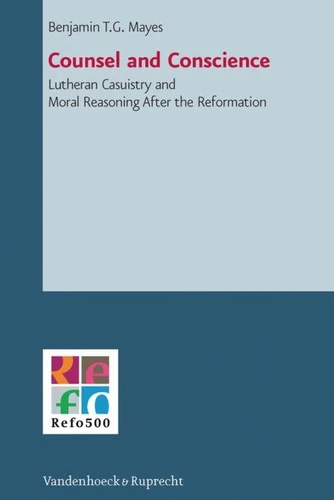
Counsel and Conscience. Lutheran Casuistry and Moral Reasoning after the Reformation
Par :Formats :
Disponible dans votre compte client Decitre ou Furet du Nord dès validation de votre commande. Le format PDF est :
- Compatible avec une lecture sur My Vivlio (smartphone, tablette, ordinateur)
- Compatible avec une lecture sur liseuses Vivlio
- Pour les liseuses autres que Vivlio, vous devez utiliser le logiciel Adobe Digital Edition. Non compatible avec la lecture sur les liseuses Kindle, Remarkable et Sony
 , qui est-ce ?
Notre partenaire de plateforme de lecture numérique où vous retrouverez l'ensemble de vos ebooks gratuitement
Pour en savoir plus sur nos ebooks, consultez notre aide en ligne ici
C'est si simple ! Lisez votre ebook avec l'app Vivlio sur votre tablette, mobile ou ordinateur :

- Nombre de pages250
- FormatPDF
- ISBN978-3-647-55027-5
- EAN9783647550275
- Date de parution17/08/2011
- Protection num.pas de protection
- Taille2 Mo
- Infos supplémentairespdf
- ÉditeurVandenhoeck & Ruprecht
Résumé
In Lutheran Germany of the post-Reformation era (ca. 1580-1750), a genre of pastoral, ethical writings arose that consisted in casuistry and in topically or thematically related theological counsels. In this first volume of the new Refo500 series Mayes shows that this casuistry literature was intended to instruct and comfort the consciences of Christians. Lutheran casuistry, related to but also distinct from Roman Catholic and Reformed counterparts, arose especially as pastors looked within Holy Scripture, the medieval tradition, and the writings of Martin Luther and other Lutheran authorities for answers to ethical problems and doctrinal disputes, and then catalogued their findings.
As an extensive example from this genre Mayes examines the Thesaurus Consiliorum Et Decisionum, published in 1671 by Georg Dedekenn and Johann Ernst Gerhard. This Thesaurus was an anthology of wise advice from Lutheran theologians and jurists, published to encourage readers to avoid individualistic ethical choices and instead to engage in an "aristocratic" process of moral decision making in which one would consult the wise men of the past and present.
The counsels included in the Thesaurus address inter-confessional disputes, intra-Lutheran disputes, sacraments, church government, pastoral ministry, social ethics, marriage, sexual ethics, and many other topics. The topics of divorce and remarriage, especially, show the different ways in which Lutherans reasoned about moral matters. The author shows that in the Thesaurus the Lutheran casuistry literature, which has been overlooked in most scholarship of the 20th and 21st centuries, was in bloom.
It arose to meet the needs of people who had doubts, and it continued to instruct and console Christian consciences for many generations.
As an extensive example from this genre Mayes examines the Thesaurus Consiliorum Et Decisionum, published in 1671 by Georg Dedekenn and Johann Ernst Gerhard. This Thesaurus was an anthology of wise advice from Lutheran theologians and jurists, published to encourage readers to avoid individualistic ethical choices and instead to engage in an "aristocratic" process of moral decision making in which one would consult the wise men of the past and present.
The counsels included in the Thesaurus address inter-confessional disputes, intra-Lutheran disputes, sacraments, church government, pastoral ministry, social ethics, marriage, sexual ethics, and many other topics. The topics of divorce and remarriage, especially, show the different ways in which Lutherans reasoned about moral matters. The author shows that in the Thesaurus the Lutheran casuistry literature, which has been overlooked in most scholarship of the 20th and 21st centuries, was in bloom.
It arose to meet the needs of people who had doubts, and it continued to instruct and console Christian consciences for many generations.