
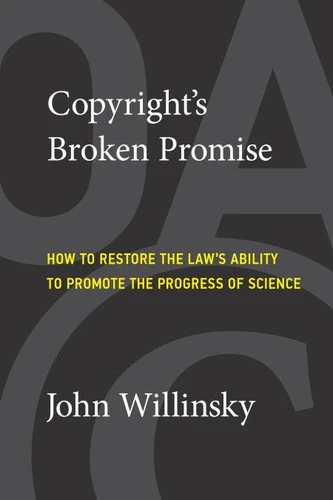
Copyright's Broken Promise. How to Restore the Law's Ability to Promote the Progress of Science
Par :Formats :
Disponible dans votre compte client Decitre ou Furet du Nord dès validation de votre commande. Le format ePub protégé est :
- Compatible avec une lecture sur My Vivlio (smartphone, tablette, ordinateur)
- Compatible avec une lecture sur liseuses Vivlio
- Pour les liseuses autres que Vivlio, vous devez utiliser le logiciel Adobe Digital Edition. Non compatible avec la lecture sur les liseuses Kindle, Remarkable et Sony
- Non compatible avec un achat hors France métropolitaine
 , qui est-ce ?
Notre partenaire de plateforme de lecture numérique où vous retrouverez l'ensemble de vos ebooks gratuitement
Pour en savoir plus sur nos ebooks, consultez notre aide en ligne ici
C'est si simple ! Lisez votre ebook avec l'app Vivlio sur votre tablette, mobile ou ordinateur :

- Nombre de pages184
- FormatePub
- ISBN978-0-262-37147-6
- EAN9780262371476
- Date de parution06/12/2022
- Protection num.Adobe DRM
- Taille752 Ko
- Infos supplémentairesepub
- ÉditeurThe MIT Press
Résumé
A comprehensive proposal for reforming copyright law to ensure sustainable public access to research and scholarship. Open access is widely supported by researchers, librarians, scholarly societies, and research funders, as well as large and small publishers. Yet despite this support-and the pandemic's demonstration of the importance of open access for scientific progress-the scholarly publishing market is failing to deliver open access quickly enough.
In Copyright's Broken Promise, John Willinsky presents the case for reforming copyright law so that it supports, rather than impedes, public access to research and scholarship. He draws on the legal strategy of statutory licensing to set out the terms and structures by which the Copyright Act could ensure that publishers are fairly compensated for providing immediate open access. What sets Willinsky's analysis apart is its focus on the current state of scholarly publishing.
Because copyright offers so little legal support for moving publishing to open access, though it is best for science, he says it is time to stop regarding the Copyright Act as a law of nature that can only be circumvented, contravened, or temporarily set aside. Specifically, he proposes that the Copyright Act add a new category of work, called "research publications, " which would be subject to statutory licensing.
This would allow publishers to receive royalty payments from the principal institutional users (universities, industry R&D, research institutes, and so on) and sponsors of the work (foundations and government agencies), while providing immediate open access.
In Copyright's Broken Promise, John Willinsky presents the case for reforming copyright law so that it supports, rather than impedes, public access to research and scholarship. He draws on the legal strategy of statutory licensing to set out the terms and structures by which the Copyright Act could ensure that publishers are fairly compensated for providing immediate open access. What sets Willinsky's analysis apart is its focus on the current state of scholarly publishing.
Because copyright offers so little legal support for moving publishing to open access, though it is best for science, he says it is time to stop regarding the Copyright Act as a law of nature that can only be circumvented, contravened, or temporarily set aside. Specifically, he proposes that the Copyright Act add a new category of work, called "research publications, " which would be subject to statutory licensing.
This would allow publishers to receive royalty payments from the principal institutional users (universities, industry R&D, research institutes, and so on) and sponsors of the work (foundations and government agencies), while providing immediate open access.