
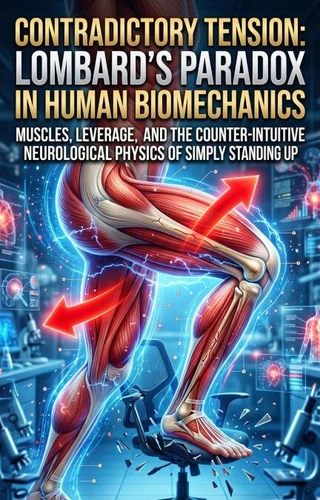
Contradictory Tension: Lombard's Paradox in Human Biomechanics. Muscles, Leverage, and the Counter-Intuitive Neurological Physics of Simply Standing Up
Par :Formats :
Disponible dans votre compte client Decitre ou Furet du Nord dès validation de votre commande. Le format ePub est :
- Compatible avec une lecture sur My Vivlio (smartphone, tablette, ordinateur)
- Compatible avec une lecture sur liseuses Vivlio
- Pour les liseuses autres que Vivlio, vous devez utiliser le logiciel Adobe Digital Edition. Non compatible avec la lecture sur les liseuses Kindle, Remarkable et Sony
 , qui est-ce ?
Notre partenaire de plateforme de lecture numérique où vous retrouverez l'ensemble de vos ebooks gratuitement
Pour en savoir plus sur nos ebooks, consultez notre aide en ligne ici
C'est si simple ! Lisez votre ebook avec l'app Vivlio sur votre tablette, mobile ou ordinateur :

- Nombre de pages155
- FormatePub
- ISBN978-3-565-46300-8
- EAN9783565463008
- Date de parution27/05/2026
- Protection num.pas de protection
- Taille781 Ko
- Infos supplémentairesepub
- ÉditeurEmphaloz Publishing House
Résumé
How is it physically possible for a human being to stand up from a seated position, given that the two major muscle groups required to perform the action actually pull the bones in completely opposite directions? This bizarre mechanical contradiction in human anatomy is known in kinesiology as Lombard's Paradox.
When you rise from a chair, you must extend both your hip and your knee. However, the rectus femoris (quadriceps) extends the knee but flexes the hip, while the hamstrings extend the hip but flex the knee.
Logically, if both muscles fire at the same time, they should perfectly cancel each other out, locking your leg in a stiff, paralyzed spasm. Yet, we stand up effortlessly. The paradox is resolved by a brilliant evolutionary hack in our mechanical leverage: because the muscles have different "moment arms" (distances from the joint center) at the hip and knee, the extension force mathematically overrides the flexion force at both joints simultaneously. This fascinating biomechanical manual dissects the hidden physics of everyday movement.
It explores the complex neurological signaling required for muscular co-contraction, the evolutionary design of the human femur, and why understanding this paradox is crucial for physical therapy and athletic performance. Appreciate the brilliant engineering of your own body. Lombard's Paradox proves that human movement is not just simple biology; it is a highly complex, flawlessly calculated symphony of physical leverage.
Logically, if both muscles fire at the same time, they should perfectly cancel each other out, locking your leg in a stiff, paralyzed spasm. Yet, we stand up effortlessly. The paradox is resolved by a brilliant evolutionary hack in our mechanical leverage: because the muscles have different "moment arms" (distances from the joint center) at the hip and knee, the extension force mathematically overrides the flexion force at both joints simultaneously. This fascinating biomechanical manual dissects the hidden physics of everyday movement.
It explores the complex neurological signaling required for muscular co-contraction, the evolutionary design of the human femur, and why understanding this paradox is crucial for physical therapy and athletic performance. Appreciate the brilliant engineering of your own body. Lombard's Paradox proves that human movement is not just simple biology; it is a highly complex, flawlessly calculated symphony of physical leverage.
