
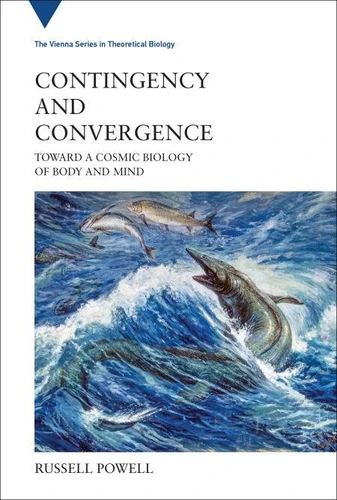
Contingency and Convergence. Toward a Cosmic Biology of Body and Mind
Par :Formats :
Disponible dans votre compte client Decitre ou Furet du Nord dès validation de votre commande. Le format ePub protégé est :
- Compatible avec une lecture sur My Vivlio (smartphone, tablette, ordinateur)
- Compatible avec une lecture sur liseuses Vivlio
- Pour les liseuses autres que Vivlio, vous devez utiliser le logiciel Adobe Digital Edition. Non compatible avec la lecture sur les liseuses Kindle, Remarkable et Sony
- Non compatible avec un achat hors France métropolitaine
 , qui est-ce ?
Notre partenaire de plateforme de lecture numérique où vous retrouverez l'ensemble de vos ebooks gratuitement
Pour en savoir plus sur nos ebooks, consultez notre aide en ligne ici
C'est si simple ! Lisez votre ebook avec l'app Vivlio sur votre tablette, mobile ou ordinateur :

- Nombre de pages328
- FormatePub
- ISBN978-0-262-35660-2
- EAN9780262356602
- Date de parution04/02/2020
- Protection num.Adobe DRM
- Taille15 Mo
- Infos supplémentairesepub
- ÉditeurThe MIT Press
Résumé
Can we can use the patterns and processes of convergent evolution to make inferences about universal laws of life, on Earth and elsewhere?In this book, Russell Powell investigates whether we can use the patterns and processes of convergent evolution to make inferences about universal laws of life, on Earth and elsewhere. Weaving together disparate philosophical and empirical threads, Powell offers the first detailed analysis of the interplay between contingency and convergence in macroevolution, as it relates to both complex life in general and cognitively complex life in particular.
If the evolution of mind is not a historical accident, the product of convergence rather than contingency, then, Powell asks, is mind likely to be an evolutionarily important feature of any living world? Stephen Jay Gould argued for the primacy of contingency in evolution. Gould's "radical contingency thesis" (RCT) has been challenged, but critics have largely failed to engage with its core claims and theoretical commitments.
Powell fills this gap. He first examines convergent regularities at both temporal and phylogenetic depths, finding evidence that both vindicates and rebuffs Gould's argument for contingency. Powell follows this partial defense of the RCT with a substantive critique. Among the evolutionary outcomes that might defy the RCT, he argues, cognition is particularly important-not only for human-specific issues of the evolution of intelligence and consciousness but also for the large-scale ecological organization of macroscopic living worlds.
Turning his attention to complex cognitive life, Powell considers what patterns of cognitive convergence tell us about the nature of mind, its evolution, and its place in the universe. If complex bodies are common in the universe, might complex minds be common as well?
If the evolution of mind is not a historical accident, the product of convergence rather than contingency, then, Powell asks, is mind likely to be an evolutionarily important feature of any living world? Stephen Jay Gould argued for the primacy of contingency in evolution. Gould's "radical contingency thesis" (RCT) has been challenged, but critics have largely failed to engage with its core claims and theoretical commitments.
Powell fills this gap. He first examines convergent regularities at both temporal and phylogenetic depths, finding evidence that both vindicates and rebuffs Gould's argument for contingency. Powell follows this partial defense of the RCT with a substantive critique. Among the evolutionary outcomes that might defy the RCT, he argues, cognition is particularly important-not only for human-specific issues of the evolution of intelligence and consciousness but also for the large-scale ecological organization of macroscopic living worlds.
Turning his attention to complex cognitive life, Powell considers what patterns of cognitive convergence tell us about the nature of mind, its evolution, and its place in the universe. If complex bodies are common in the universe, might complex minds be common as well?